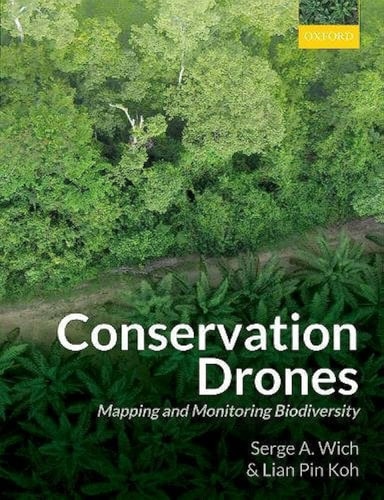
Conservation Drones: Mapping and Monitoring Biodiversity
0
0
As an Amazon Associate and affiliate partner, Menrva Books earns from qualifying purchases. Learn more
Author Description
Increasing numbers of ecologists and conservation biologists have begun to explore the use of drone technology to obtain accurate and up-to-date data on the distribution and density of species, as well as the threats to their habitats, in their ongoing attempts to conserve and monitor biodiversity. Conservation drones are low-cost, autonomous, and operator-friendly unmanned aerial vehicles that can be used for surveying, mapping, and monitoring both habitat and biodiversity. They are fast becoming a valuable complement to ground-based surveys and satellite imagery for a wide range of ecological and conservation applications. The authors pioneered the use of conservation drones for the purpose of monitoring orangutan populations in Southeast Asia. They subsequently founded ConservationDrones.org to share their knowledge of building and using drones with colleagues in the wider environmental community. This website has proved highly popular and this book aims to further build capacity to use drones and inspire others to adapt emerging technologies for practical conservation.
Menrva's Summary
THE THESIS
This book investigates how unmanned aerial vehicle technology can be effectively integrated into ecological research and biodiversity conservation efforts. The authors, Lian Pin Koh and Serge A. Wich, draw upon their pioneering field work in Southeast Asia to provide a technical framework for deploying drones. They argue that these autonomous systems offer a scalable, cost-effective alternative to traditional survey methods, bridging the gap between ground-level observation and satellite-based remote sensing. By documenting their own experiences and the development of the ConservationDrones.org platform, they establish a practical guide for environmental professionals to adopt emerging aerial technologies.
THE SCOPE MAP
What You Will Find
- Technical specifications for low-cost, autonomous unmanned aerial vehicles suitable for field use.
- Methodologies for surveying, mapping, and monitoring species distribution and habitat density.
- Case studies detailing the application of drone technology in monitoring orangutan populations.
- Best practices for building and operating drone fleets within the environmental conservation community.
THE AUTHORITY PERSPECTIVE
Experts recognize this work as a foundational text for ecologists seeking to implement aerial surveillance in their research. Readers frequently note that the prose balances technical instruction with clear, actionable advice for field biologists.
Page Count:
144
Publication Date:
2018-08-21
Publisher:
Oxford University Press
ISBN-10:
0198787618
ISBN-13:
9780198787617
Science
Conservation
Drone Aircraft
Trades & Technology
Technology
Biology
Ecology
Environmental
Nature conservation
Biodiversity conservation
Community Tags
Similar Books