How to Fold It
0
0
As an Amazon Associate and affiliate partner, Menrva Books earns from qualifying purchases. Learn more
Author Description
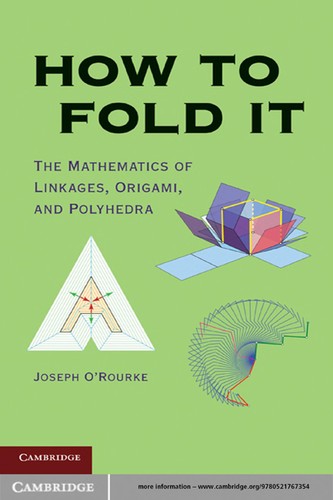
What do proteins and pop-up cards have in common? How is opening a grocery bag different from opening a gift box? How can you cut out the letters for a whole word all at once with one straight scissors cut? How many ways are there to flatten a cube? With the help of 200 colour figures, author Joseph O'Rourke explains these fascinating folding problems starting from high school algebra and geometry and introducing more advanced concepts in tangible contexts as they arise. He shows how variations on these basic problems lead directly to the frontiers of current mathematical research and offers ten accessible unsolved problems for the enterprising reader. Before tackling these, you can test your skills on fifty exercises with complete solutions. The book's website, http://www.howtofoldit.org, has dynamic animations of many of the foldings and downloadable templates for readers to fold or cut out
Menrva's Summary
THE THESIS
This book investigates the mathematical principles behind folding objects, exploring connections between seemingly disparate fields like protein folding and pop-up cards. Joseph O'Rourke, drawing on his expertise, guides readers from high school algebra and geometry into more advanced mathematical concepts through tangible examples. The book utilizes 200 color figures to illustrate these concepts, demonstrating how basic folding problems can lead to the frontiers of current mathematical research. It also offers ten unsolved problems for readers to explore, alongside fifty exercises with complete solutions.
THE SCOPE MAP
- Exploration of folding problems in mathematics, including protein folding and pop-up cards.
- Introduction of advanced mathematical concepts through accessible contexts.
- Use of 200 color figures to illustrate folding principles.
- Discussion of how basic folding problems relate to current mathematical research.
- Presentation of ten unsolved problems for reader engagement.
- Inclusion of fifty exercises with complete solutions.
- Companion website with dynamic animations and downloadable templates.
THE AUTHORITY PERSPECTIVE
The book is presented as an accessible exploration of mathematical folding problems, suitable for readers with a background in high school algebra and geometry. It aims to bridge the gap between basic concepts and advanced research, offering both challenges and solutions. The inclusion of visual aids and interactive elements suggests a pedagogical approach designed to engage the reader actively with the material. The book's structure, moving from foundational principles to open research questions, indicates a comprehensive yet approachable treatment of its subject matter.
Page Count:
177
Publication Date:
2011-01-01
ISBN-10:
0521767350
ISBN-13:
9780521767354
Science
Non-Fiction
Geometry
Recreational Mathematics
Origami
Mathematics
Community Tags
Similar Books