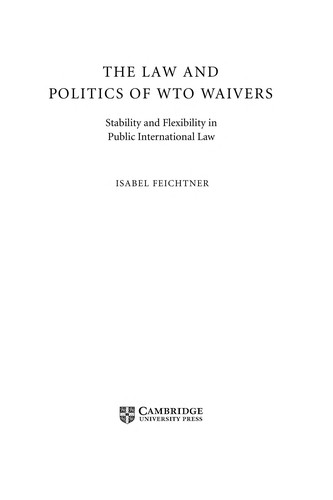
The Law and Politics of WTO Waivers
0
0
As an Amazon Associate and affiliate partner, Menrva Books earns from qualifying purchases. Learn more
Author Description
Despite being an important legal instrument in the law of the WTO, the waiver has hitherto been the subject of little scholarly analysis. Isabel Feichtner fills this gap by challenging the conventional view that the WTO's political bodies do not engage in significant law-making. She systemises the GATT and WTO waiver practice and suggests a typology of waivers as individual exception, general exception and rule-making instruments. She also presents the procedural and substantive legal requirements for the granting of waivers, deals with questions of judicial review and interpretation of waiver decisions, and clarifies the waiver's potential and limits for addressing the need for flexibility and adaptability in public international law and WTO law in particular. By connecting the analysis of waiver competence and waiver practice to the general stability/flexibility challenge in public international law, the book sheds new light on the WTO, international institutions and international law. International law and institutions increasingly not only deal with transactions across the borders of sovereign states, but instead promote and protect transnational societal interests. To give but a few examples: international legal regimes obligate states to limit greenhouse gas emissions by national households and industry, to put into place administrative and judicial procedures for the protection of intellectual property rights, or they restrict domestic governmental powers to adopt policies that encroach upon human rights or impede international trade. The observation that international law promotes transnationally shared societal interests, such as interests in a clean environment, cross-border trade, property or human rights protection does not implicate a value judgment. It does not follow that such law is beyond criticism and exclusively for the good of human kind. Rather it implicates trade-offs -trade-offs between economic and non-economic interests, for example, or
Menrva's Summary
THE THESIS
This book investigates the under-analyzed legal instrument of waivers within the World Trade Organization (WTO) framework. It challenges the notion that WTO political bodies are not significant law-makers by systematically analyzing GATT and WTO waiver practices. The author proposes a typology of waivers and details the procedural and substantive requirements for their granting, alongside discussions on judicial review and interpretation. The work further explores the potential and limitations of waivers for ensuring flexibility and adaptability in public international law, particularly within WTO law.
THE SCOPE MAP
- Analysis of the GATT and WTO waiver practice
- Typology of waivers: individual exception, general exception, and rule-making instruments
- Procedural and substantive legal requirements for granting waivers
- Questions of judicial review and interpretation of waiver decisions
- The potential and limits of waivers for flexibility and adaptability in public international law
- Connection to the general stability/flexibility challenge in public international law
- Examination of how international law promotes transnational societal interests
THE AUTHORITY PERSPECTIVE
The book addresses a gap in scholarly analysis concerning WTO waivers, a crucial legal instrument. It offers a systematic approach to waiver practice and proposes a new typology, providing a detailed examination of legal requirements and review processes. By linking waiver competence to broader challenges in international law, the work aims to illuminate the functioning of the WTO and international institutions. The analysis suggests that international law increasingly mediates transnational societal interests, involving complex trade-offs.
Page Count:
0
Publication Date:
2011-01-01
ISBN-10:
1107012899
ISBN-13:
9781107012899
Economics
Non-Fiction
Politics
International Law
Legal Studies
Trade Law
Community Tags
Similar Books