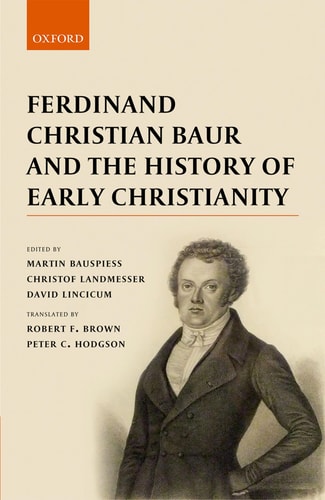
Ferdinand Christian Baur and the History of Early Christianity
0
0
As an Amazon Associate and affiliate partner, Menrva Books earns from qualifying purchases. Learn more
Author Description
Ferdinand Christian Baur (1792-1860) has been described as "the greatest and at the same time the most controversial theologian in German Protestant theology since Schleiermacher." The controversy was epitomized by a nineteenth-century British critic who wrote that his theory "makes of Christianity a thing of purely natural origin, calls in question the authenticity of all but a few of the New Testament books, and makes the whole collection contain not a harmonious system of divine truth, but a confused mass of merely human and contradictory opinions as to the nature of the Christian religion." The contributors to this volume, however, regard Baur as an epoch-making New Testament scholar whose methods and conclusions, though superseded, have been mostly affirmed during the century and a half since his death. This collection focuses on the history of early Christianity, although as a historian of the church and theology Baur covered the entire field up to own time. He combined the most exacting historical research with a theological interpretation of history influenced by Kant, Schelling, and Hegel. The first three chapters discuss Baur's relation to Strauss, Mohler, and Hegel. Then a central core of chapters considers his historical and exegetical perspectives (Judaism and Hellenism, Gnosticism, New Testament introduction and theology, the Pauline epistles, the Synoptic Gospels, John, the critique of miracle, and the combination of absoluteness and relativity). The final chapters view his influence by analyzing the reception of Baur in Britain, Baur and Harnack, and Baur and practical theology. This work offers a multi-faceted picture of his thinking, which will stimulate contemporary discussion.
Menrva's Summary
THE THESIS
This volume investigates the enduring significance and controversial legacy of Ferdinand Christian Baur, a pivotal figure in nineteenth-century German Protestant theology. Edited by Peter C. Hodgson and Robert F. Brown, the text assembles scholarly contributions that re-evaluate Baur’s methodology, which integrated rigorous historical research with philosophical frameworks derived from Kant, Schelling, and Hegel. The authors argue that while Baur’s specific conclusions have been superseded, his foundational approach to New Testament scholarship remains an essential touchstone for understanding the historical development of early Christianity.
THE SCOPE MAP
What You Will Find
- Analysis of Baur’s intellectual engagement with contemporaries such as Strauss, Mohler, and Hegel.
- Examination of Baur’s exegetical perspectives on Gnosticism, the Pauline epistles, and the Synoptic Gospels.
- Historical assessment of Baur’s reception in Britain and his influence on subsequent scholars like Harnack.
- Discussion of the intersection between historical criticism, the critique of miracles, and practical theology.
THE AUTHORITY PERSPECTIVE
Scholars and theologians recognize this collection as a comprehensive resource for understanding the evolution of modern biblical criticism. Readers frequently note the academic density of the prose, which serves as a specialized reference for those studying the history of German theological thought.
Page Count:
432
Publication Date:
2017-05-03
Publisher:
Oxford University Press
ISBN-10:
0198798415
ISBN-13:
9780198798415
History
Biography
Philosophy
Theology
Christianity
Church History
Academic
Community Tags
Similar Books