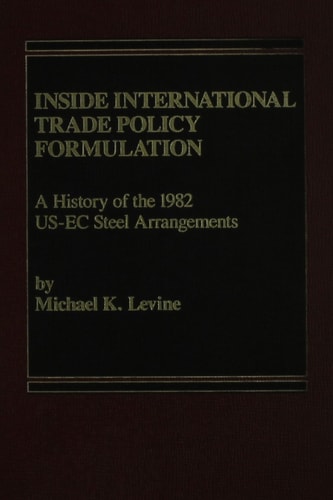
Inside international trade policy formulation: A history of the 1982 US-EC steel arrangements
0
0
As an Amazon Associate and affiliate partner, Menrva Books earns from qualifying purchases. Learn more
Author Description
This book describes in detail the negotiation of the 1982 U.S.-E.C. Steel Trade Arrangements, providing all the necessary background information including the first authoritative post-mortem of the Steel Trigger Price Mechanism. Levine shows how the 1982 Arrangements evolved from an interplay of U.S. laws defining and enforcing fair trade, economic and industrial developments, U.S. and European domestic politics, international relations, and simple economic self-interest. The author contends that the U.S. steel industry was able to use leverage created by a judicialized system of trade dispute settlement to force the U.S. Government to accept a political system of import protection that it would otherwise have refused.
Menrva's Summary
THE THESIS
This book investigates how the 1982 U.S.-E.C. Steel Trade Arrangements were formulated through the complex intersection of judicial trade enforcement, domestic political pressure, and international economic interests. Michael K. Levine, drawing on his expertise in trade policy, analyzes the evolution of these arrangements by examining the interplay between U.S. fair trade laws and the strategic maneuvers of the steel industry. The author argues that the industry successfully leveraged a judicialized dispute settlement system to compel the government to adopt protectionist measures that were initially resisted by policymakers.
THE SCOPE MAP
What You Will Find
- Detailed history of the 1982 U.S.-E.C. Steel Trade Arrangements
- Analysis of the Steel Trigger Price Mechanism
- Examination of the influence of domestic politics on international trade policy
Scope Limits
- Does not cover steel trade policy developments occurring after the 1982 agreements
- Focuses primarily on the U.S.-European dynamic rather than global steel trade trends
THE AUTHORITY PERSPECTIVE
Experts and scholars of international trade policy recognize this work as a detailed case study on the mechanics of protectionist negotiation. Readers frequently note the technical density of the prose, which provides a granular look at the intersection of law and industrial policy.
Page Count:
164
Publication Date:
1985-01-01
Publisher:
Praeger
ISBN-10:
0030033683
ISBN-13:
9780030033681
History
Economics
Industrial Relations
Public Policy
International Trade
Economics
International
Community Tags
Similar Books