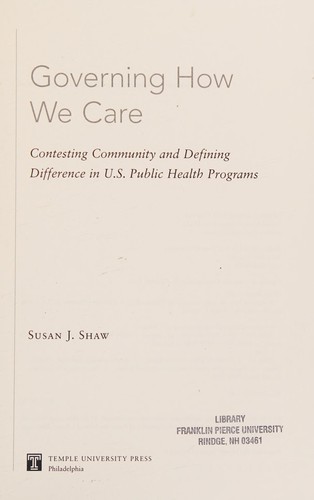
Governing how we care
0
0
As an Amazon Associate and affiliate partner, Menrva Books earns from qualifying purchases. Learn more
Author Description
As local governments and organizations assume more responsibility for ensuring the public health, identity politics play an increasing yet largely unexamined role in public and policy attitudes toward local problems. In Governing How We Care, medical anthropologist Susan Shaw examines the relationship between government and citizens using case studies of needle exchange and Welfare-to-Work programs to illustrate the meanings of cultural difference, ethnicity, and inequality in health care. Drawing on ethnographic research conducted over six years in a small New England city, Shaw presents critical perspectives on public health intervention efforts. She looks at online developments in health care and makes important correlations between poverty and health care in the urban United States. Shaw also highlights the new concepts of community and forms of identity that emerge in our efforts to provide effective health care. Governing How We Care shows how government-sponsored community health and health care programs operate in an age of neoliberalism
Menrva's Summary
THE THESIS
This book investigates the complex interplay between local governance, identity politics, and public health initiatives in the United States. Medical anthropologist Susan Shaw draws on six years of ethnographic research in a New England city to analyze how cultural differences, ethnicity, and inequality shape public and policy attitudes towards local health problems. The book uses case studies of needle exchange and Welfare-to-Work programs to critically examine public health interventions, explore online developments in healthcare, and highlight the correlations between poverty and healthcare access in urban settings. Shaw also considers the evolving concepts of community and identity that emerge from these healthcare provision efforts within the context of neoliberalism.
THE SCOPE MAP
- Analysis of needle exchange programs as a case study in public health intervention.
- Examination of Welfare-to-Work programs and their impact on health and identity.
- Ethnographic research conducted over six years in a small New England city.
- Critical perspectives on public health intervention efforts.
- Exploration of online developments in healthcare.
- Correlations between poverty and healthcare in the urban United States.
- New concepts of community and forms of identity emerging in healthcare provision.
- Operation of government-sponsored community health and healthcare programs in an age of neoliberalism.
THE AUTHORITY PERSPECTIVE
The book is presented as a critical examination of how local governments and organizations approach public health, with a particular focus on the unexamined role of identity politics. It draws on extensive ethnographic research to provide nuanced perspectives on the meanings of cultural difference, ethnicity, and inequality within healthcare systems. The work highlights the connections between poverty and healthcare access in urban America and considers how community and identity are reshaped by these programs. The author's approach suggests a deep engagement with the practical realities of public health policy and its social implications.
Page Count:
214
Publication Date:
2012-01-01
ISBN-10:
1439906823
ISBN-13:
9781439906828
Politics
Non-Fiction
Health
Sociology
Medical Anthropology
Urban Studies
Public Health
Community Tags
Similar Books