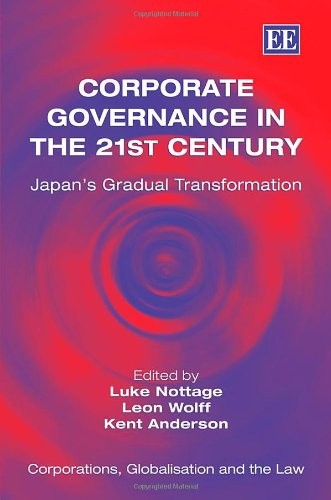
Corporate Governance in the 21st Century
0
0
As an Amazon Associate and affiliate partner, Menrva Books earns from qualifying purchases. Learn more
Author Description
The 'lost decade' of economic stagnation in Japan during the 1990s has become a 'found decade' for regulatory and institutional reform. Nowhere is this more evident than in corporate law. In 2005, for example, a spate of reforms to the Commercial Code culminated in the new Company Act, a statute promising greater organisational flexibility and shareholder empowerment for Japanese corporations competing in a more globalised economy. But does this new law herald a more 'Americanised' system of corporate governance? Has Japan embraced shareholder primacy over its traditional loyalty to other key stakeholders such as 'main banks', core employees, and partners within diffuse corporate (keiretsu) groups? This book argues that a more complex 'gradual transformation' is unfolding in Japan - a process evident in many other post-industrial economies.
Menrva's Summary
THE THESIS
This book investigates the extent to which Japan's corporate governance reforms, particularly the 2005 Company Act, represent a fundamental shift towards a shareholder-centric model or a more gradual, complex transformation. The author, Luke Nottage, examines the impact of the 'lost decade' of economic stagnation on regulatory and institutional reform in Japan. The book challenges the notion of a simple 'Americanisation' of Japanese corporate law, exploring whether the new statute truly prioritizes shareholder empowerment over traditional stakeholder loyalties to 'main banks', employees, and keiretsu groups. It posits that a more nuanced, gradual evolution is occurring, a process mirrored in other post-industrial economies.
THE SCOPE MAP
- Analysis of the 'lost decade' of economic stagnation in Japan and its impact on corporate law.
- Detailed examination of the 2005 Company Act and its provisions for organizational flexibility and shareholder empowerment.
- Comparative study of Japanese corporate governance against 'Americanised' models.
- Exploration of the tension between shareholder primacy and traditional stakeholder loyalties (main banks, employees, keiretsu).
- Argument for a 'gradual transformation' in Japanese corporate governance.
- Discussion of how this transformation compares to trends in other post-industrial economies.
THE AUTHORITY PERSPECTIVE
The book is framed as an analytical argument concerning the nature of corporate governance reform in Japan. It posits a 'gradual transformation' rather than a radical shift, suggesting a nuanced evolution in response to economic challenges. The work appears to engage with academic and policy debates surrounding the influence of global economic trends on national corporate structures. Its focus on stakeholder relationships and legal statutes indicates a readership interested in comparative business law and economic history.
Page Count:
288
Publication Date:
2008-01-01
ISBN-10:
1847209238
ISBN-13:
9781847209238
Non-Fiction
Business
Economics
Law
Corporate governance
Community Tags
Similar Books