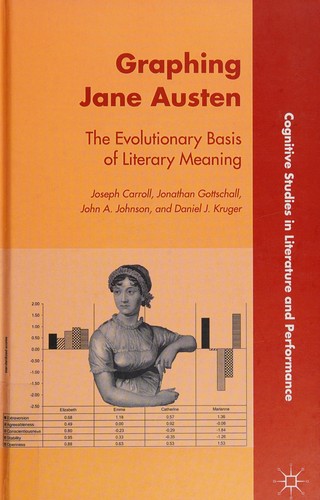
Graphing Jane Austen
0
0
As an Amazon Associate and affiliate partner, Menrva Books earns from qualifying purchases. Learn more
Author Description
Building on findings in the evolutionary human sciences, we constructed a model of human nature and used it to illuminate the evolved psychology that shapes the organization of characters in nineteenth-century British novels (Austen to Forster). Hundreds of readers gave numerical ratings to the attributes of hundreds of characters and also rated their own emotional responses to the characters. We draw conclusions about the determinacy of literary meaning, interactions between gender and the ethos of community, and the adaptive function of morally polarized characterization. The broad patterns in the novels provide a framework for two case studies: the novels of Jane Austen and Thomas Hardy's The Mayor of Casterbridge.
Menrva's Summary
THE THESIS
This book applies evolutionary human sciences to analyze character organization in 19th-century British novels. The author, Joseph Carroll, constructs a model of human nature to illuminate the evolved psychology shaping these characters, drawing on reader ratings of character attributes and emotional responses. The study investigates the determinacy of literary meaning, the interplay of gender and community ethos, and the adaptive function of morally polarized characterization, with focused case studies on Jane Austen and Thomas Hardy.
THE SCOPE MAP
- Analysis of character organization in 19th-century British novels (Austen to Forster).
- Application of a model of human nature derived from evolutionary human sciences.
- Use of reader ratings for character attributes and emotional responses.
- Examination of the determinacy of literary meaning.
- Exploration of interactions between gender and community ethos.
- Investigation into the adaptive function of morally polarized characterization.
- Case studies on the novels of Jane Austen.
- Case study on Thomas Hardy's The Mayor of Casterbridge.
THE AUTHORITY PERSPECTIVE
This work presents a rigorous academic analysis, applying a specific theoretical framework from evolutionary psychology to literary studies. Its methodology, relying on quantitative reader data and detailed textual analysis, suggests a dense, scholarly approach aimed at specialists in literary criticism and evolutionary psychology. The focus on established authors like Austen and Hardy indicates an engagement with canonical works to test broader theories of literary meaning and character construction.
Page Count:
305
Publication Date:
2012-01-01
ISBN-10:
1137002409
ISBN-13:
9781137002402
Fiction
Non-Fiction
Psychology
History
Evolutionary Psychology
British literature
Literary History
Literary Criticism
Community Tags
Similar Books