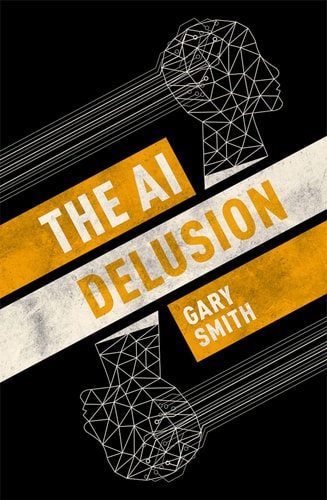
The AI Delusion
0
0
As an Amazon Associate and affiliate partner, Menrva Books earns from qualifying purchases. Learn more
Author Description
We live in an incredible period in history. The Computer Revolution may be even more life-changing than the Industrial Revolution. We can do things with computers that could never be done before, and computers can do things for us that could never be done before.But our love of computers should not cloud our thinking about their limitations.We are told that computers are smarter than humans and that data mining can identify previously unknown truths, or make discoveries that will revolutionize our lives. Our lives may well be changed, but not necessarily for the better. Computers are very good at discovering patterns, but are useless in judging whether the unearthed patterns are sensible because computers do not think the way humans think.We fear that super-intelligent machines will decide to protect themselves by enslaving or eliminating humans. But the real danger is not that computers are smarter than us, but that we think computers are smarter than us and, so, trust computers to make important decisions for us.The AI Delusion explains why we should not be intimidated into thinking that computers are infallible, that data-mining is knowledge discovery, and that black boxes should be trusted.
Menrva's Summary
THE THESIS
The book investigates the core question of whether the current societal reliance on artificial intelligence and data mining is based on a fundamental misunderstanding of machine capabilities versus human judgment. Gary D. Smith, a professor of economics and statistics, utilizes his background in quantitative analysis to challenge the prevailing narrative of machine infallibility. He argues that while computers excel at pattern recognition, they lack the capacity for contextual reasoning, leading to significant risks when humans delegate critical decision-making to algorithmic black boxes.
THE SCOPE MAP
What You Will Find
- Analysis of the limitations inherent in data mining and pattern discovery methodologies.
- Critique of the societal tendency to anthropomorphize computer intelligence.
- Examination of the risks associated with trusting black box algorithms for high-stakes decision-making.
- Comparison between human cognitive processes and computational logic.
THE AUTHORITY PERSPECTIVE
Experts and readers frequently note that the text provides a necessary counter-narrative to the hype surrounding modern machine learning. The prose is accessible to a general audience while maintaining a rigorous focus on the logical fallacies often ignored in tech-centric discourse.
Page Count:
256
Publication Date:
2018-10-01
Publisher:
Oxford University Press
ISBN-10:
0198824300
ISBN-13:
9780198824305
Philosophy
Technology
Data Science
Professional Career & Trade
Human Interaction
Computer Science
Sociology
Computers
Community Tags
Similar Books