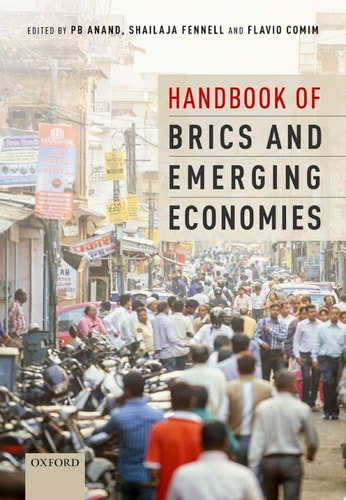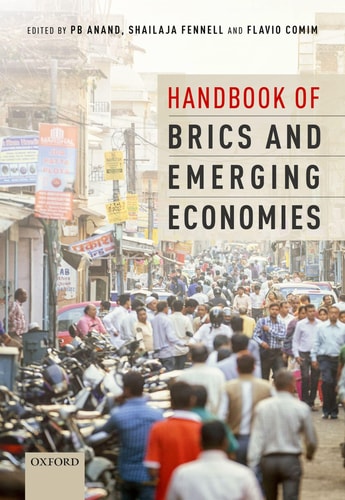
Handbook of BRICS and Emerging Economies
0
0
As an Amazon Associate and affiliate partner, Menrva Books earns from qualifying purchases. Learn more
Author Description
Ever since Jim O'Neill at Goldman Sachs coined the term BRICS in 2001 there have been many different assessments of these major emerging economies, with some even proclaiming that the promise of the BRICS (comprising Brazil, Russia, India, China, and South Africa) is over. However, the so called 'arranged marriage' still seems to be working well, with the club having become a formal international forum, with summit declarations, ministerial meetings, and numerous BRICS-wide fora. Is this euphoria misplaced? Is there a BRICS model of economic and human development? Are inequalities increasing and is this the denouncement of the economic successes? Are geo-political tensions rising between these nations?During the post COVID-19 situation, the importance of bilateral and multilateral co-operation mechanisms and institutions is becoming clear. This book focuses on one such emerging co-operation mechanism of BRICS but also more widely on those five countries and other similar economies. As a global depression looms large, global economic recovery depends on the performance of not only its largest economies but also many other important and significant economies within the so called G20 group. Even prior to the COVID-19 outbreak multilateral institutions have been under considerable strain, as with the relationship between the United States of America and China, and risks to global economic recovery appear very real. This book brings together multi-disciplinary perspectives from over sixty scholars and it presents a comprehensive and deep dive into the BRICS and emerging economies and into an understanding the political, economic, and social contexts that can help in designing approaches for recovery and regaining the last momentum in the journey towards the Sustainable Development Goals.
Menrva's Summary
THE THESIS
This volume investigates whether the BRICS nations represent a coherent model for economic and human development amidst shifting global geopolitical tensions and post-pandemic recovery challenges. Editors Flavio Comim, P. B. Anand, and Shailaja Fennell curate a multi-disciplinary analysis from over sixty scholars to evaluate the efficacy of BRICS as an international forum. The text examines whether the economic successes of these nations are sustainable or if rising inequalities and geopolitical friction threaten their collective momentum toward the Sustainable Development Goals.
THE SCOPE MAP
What You Will Find
- Comprehensive analysis of the economic, political, and social contexts of Brazil, Russia, India, China, and South Africa.
- Evaluation of multilateral cooperation mechanisms in the post-COVID-19 global landscape.
- Multi-disciplinary research contributions from over sixty international scholars.
- Strategic frameworks for addressing global economic recovery and the Sustainable Development Goals.
THE AUTHORITY PERSPECTIVE
Experts identify this work as a significant academic resource for understanding the complex institutional dynamics of emerging economies. Readers frequently note the density of the text, which provides a rigorous, multi-faceted examination suitable for scholars and policy analysts interested in global economic governance.
Page Count:
1184
Publication Date:
2020-12-20
Publisher:
Oxford University Press
ISBN-10:
0198827539
ISBN-13:
9780198827535
Economics
Global Studies
International relations
Developing Countries
Community Tags
Similar Books