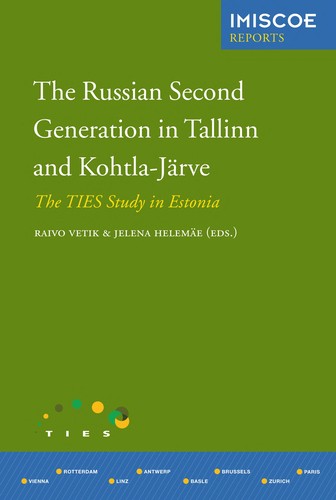
The Russian Second Generation in Tallinn and Kohtla-Järve
0
0
As an Amazon Associate and affiliate partner, Menrva Books earns from qualifying purchases. Learn more
Author Description
Second-generation Russians face two major integration challenges in the Estonian cities of Tallinn and Kohtla-Järve. They are segregated from an Estonian language society whose historical background lies in the policies and social processes of the former Soviet Union. And, compared to their peers, they face an emerging disparity in social and economic opportunities. Such inequality comes largely as the result of newly formed, post-independence institutions, which incite protest among young Russians. With a potential to escalate into large-scale conflict, as exemplified by the Bronze Soldier crisis in April 2007, it is crucial to learn more about this dissatisfaction and the generation in whom it is found. As the second country report of the TIES Project (Towards the Integration of the European Second Generation), this volume sheds light on how various factors can impact integration and how actors can use socio-economic and cultural resources in their adaptation process - in Estonia and beyond.
Menrva's Summary
THE THESIS
The integration of second-generation Russians in Estonia presents complex challenges rooted in historical Soviet policies and post-independence societal shifts. The book examines the dual pressures of linguistic segregation from Estonian society and emerging socio-economic disparities faced by young Russians in Tallinn and Kohtla-Järve. These inequalities, stemming from newly formed institutions, fuel discontent and protest, posing a potential risk for larger societal conflict. This study, as part of the TIES Project, investigates the factors influencing integration and the adaptive strategies employed by this demographic.
THE SCOPE MAP
- Analysis of integration challenges for second-generation Russians in Tallinn and Kohtla-Järve.
- Examination of historical Soviet policies and their impact on contemporary Estonian society.
- Investigation into socio-economic disparities and their role in inciting protest among young Russians.
- Case study of the Bronze Soldier crisis in April 2007 as an example of escalating conflict.
- Exploration of adaptation processes using socio-economic and cultural resources.
- Contribution to the TIES Project (Towards the Integration of the European Second Generation).
THE AUTHORITY PERSPECTIVE
This volume, as the second country report of the TIES Project, offers a detailed examination of the integration challenges faced by second-generation Russians in Estonia. It highlights the critical interplay between historical Soviet policies, post-independence institutional changes, and the resulting socio-economic disparities. The book's analysis is crucial for understanding the potential for social unrest and for developing effective integration strategies within Estonia and potentially other European contexts.
Page Count:
242
Publication Date:
2011-01-01
ISBN-10:
9089642501
ISBN-13:
9789089642509
History
Politics
Non-Fiction
Sociology
Demographics
Social Issues
Community Tags
Similar Books