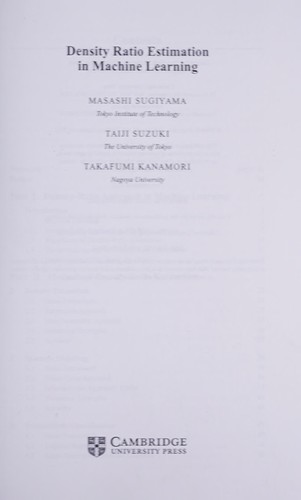
Density Ratio Estimation in Machine Learning
0
0
As an Amazon Associate and affiliate partner, Menrva Books earns from qualifying purchases. Learn more
Author Description
Machine learning is an interdisciplinary field of science and engineering that studies mathematical theories and practical applications of systems that learn. This book introduces theories, methods, and applications of density ratio estimation, which is a newly emerging paradigm in the machine learning community. Various machine learning problems such as nonstationarity adaptation, outlier detection, dimensionality reduction, independent component analysis, clustering, classification, and conditional density estimation can be systematically solved via the estimation of probability density ratios. The authors offer a comprehensive introduction of various density ratio estimators including methods via density estimation, moment matching, probabilistic classification, density fitting, and density ratio fitting as well as describing how these can be applied to machine learning. The book also provides mathematical theories for density ratio estimation including parametric and non-parametric convergence analysis and numerical stability analysis to complete the first and definitive treatment of the entire framework of density ratio estimation in machine learning
Menrva's Summary
THE THESIS
This book investigates the theoretical underpinnings and practical applications of density ratio estimation within the field of machine learning. The authors, drawing on their expertise, present density ratio estimation as a unifying paradigm capable of addressing a wide array of machine learning challenges, including adaptation to changing data distributions, outlier detection, and classification. The text systematically introduces various estimation methods and provides rigorous mathematical analysis, including convergence and stability, to establish a definitive treatment of the subject.
THE SCOPE MAP
- Theories, methods, and applications of density ratio estimation.
- Systematic solutions to machine learning problems via density ratio estimation (e.g., nonstationarity adaptation, outlier detection, classification).
- Comprehensive introduction to various density ratio estimators (density estimation, moment matching, probabilistic classification, density fitting, density ratio fitting).
- Mathematical theories for density ratio estimation, including parametric and non-parametric convergence analysis and numerical stability analysis.
THE AUTHORITY PERSPECTIVE
This work is positioned as a definitive treatment of density ratio estimation in machine learning. The comprehensive scope and theoretical depth suggest it is aimed at researchers and practitioners seeking a thorough understanding of the subject. Its detailed mathematical analysis indicates a rigorous approach, likely appealing to those with a strong background in statistics and machine learning.
Page Count:
329
Publication Date:
2012-01-01
ISBN-10:
0521190177
ISBN-13:
9780521190176
Science
Non-Fiction
Data Science
Machine Learning
Statistics
Community Tags
Similar Books