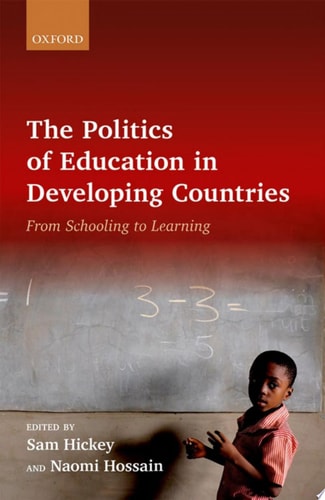
The Politics of Education in Developing Countries: From Schooling to Learning
0
0
As an Amazon Associate and affiliate partner, Menrva Books earns from qualifying purchases. Learn more
Author Description
Why have many developing countries that have succeeded in expanding access to education made such limited progress on improving learning outcomes? There is a growing recognition that the learning crisis constitutes a significant dimension of global inequality and also that educational outcomes in developing countries are shaped by political as well as socio-economic and other factors. The Politics of Education in Developing Countries focuses on how politics shapes the capacity and commitment of elites to tackle the learning crisis in six developing countries: Bangladesh, Cambodia, Ghana, Rwanda, South Africa, and Uganda.The problem of education quality is serious across the Global South. The Politics of Education in Developing Countries: From Schooling to Learning deploys a new conceptual framework-the domains of power approach-to show how the type of political settlement shapes the level of elite commitment and state capacity to improving learning outcomes. The domain of education is prone to being highly politicized, as it offers an important source of both rents and legitimacy to political elites, and can be central to paradigmatic elite ideas around nation-building and modernity. Of particular importance is the relative strength of coalitions pushing for access as against those focused on issues of higher quality education. This book concludes with a discussion of entry points and strategies for thinking and working politically in relation to education quality reforms and critical commentaries.
Menrva's Summary
THE THESIS
This book investigates why many developing nations have achieved significant gains in school enrollment while simultaneously failing to improve actual student learning outcomes. Authors Sam Hickey and Naomi Hossain utilize a political economy lens to argue that educational quality is not merely a technical challenge but a product of political settlements. By examining the interests, incentives, and power dynamics of political elites, the authors demonstrate how state capacity and commitment are constrained or enabled by the specific political environments within the Global South.
THE SCOPE MAP
What You Will Find
- A comparative analysis of education policy across Bangladesh, Cambodia, Ghana, Rwanda, South Africa, and Uganda.
- The application of the 'domains of power' conceptual framework to explain educational reform trajectories.
- Examination of how political elites utilize education systems for legitimacy, rent-seeking, and nation-building.
- Strategic entry points for policy practitioners to navigate political constraints when advocating for quality-focused reforms.
THE AUTHORITY PERSPECTIVE
Experts identify this work as a significant contribution to the field of international development, particularly for its focus on the political economy of education. Readers frequently note the academic density of the prose, which provides a rigorous framework for understanding why technical policy interventions often fail in complex political landscapes.
Page Count:
256
Publication Date:
2019-05-07
Publisher:
Oxford University Press
ISBN-10:
019883568X
ISBN-13:
9780198835684
Education
Public Policy
Sociology
Political Aspects
Community Tags
Similar Books