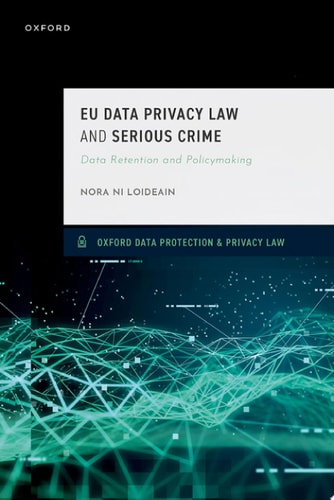
EU Data Privacy Law and Serious Crime: Data Retention and Policymaking
0
0
As an Amazon Associate and affiliate partner, Menrva Books earns from qualifying purchases. Learn more
Author Description
This book provides the first comprehensive doctrinal and comparative study to examine the influence of the fundamental human right to respect for private life on data retention within EU law, specifically communications data and passenger name record data, for the purpose of countering serious crime. First, it is the only academic publication that offers a complete picture of the EU's institutions, not just the Court of Justice of the EU, at work in a legally and politically sensitive field from a variety of perspectives, thereby contributing to a scholarly understanding of topics which tend to attract generalized opinions not based on detailed analysis of law and practice in specific areas. Secondly, this original analysis of EU data retention law casts a spotlight on the real and actual extent of the weight now being given in the mainstreaming of fundamental rights within the EU policymaking process, providing a more complete picture of the role and impact of human rights on this area of law and policymaking. Thirdly, this book is the only work to outline and examine in detail the impact of the tensions and dialogue between the EU and European Convention on Human Rights (ECHR) legal systems within the case law of both courts on data privacy and serious crime. In addition, this book also sets out the implications of the above analysis, and recent landmark jurisprudence on Article 8 ECHR and Articles 7 and 8 of the EU Charter of Fundamental Rights, for new related EU legislation, including Directive 2016/680 on data processing for the purposes of the prevention, investigation, detection or prosecution of criminal offences and relevant provisions of the forthcoming E-Privacy Regulation.
Menrva's Summary
THE THESIS
This book investigates the complex intersection of fundamental human rights and data retention policies within the European Union, specifically regarding the balance between privacy and the investigation of serious crime. Nora Ni Loideain, a legal scholar, utilizes a doctrinal and comparative methodology to analyze how the Court of Justice of the EU and other institutions navigate the tensions between security mandates and the European Convention on Human Rights. The work provides a rigorous examination of how legal frameworks, such as the EU Charter of Fundamental Rights, influence the development of legislation concerning communications data and passenger name records.
THE SCOPE MAP
What You Will Find
- Comparative analysis of EU and ECHR legal systems regarding data privacy.
- Examination of Directive 2016/680 and the E-Privacy Regulation.
- Evaluation of landmark jurisprudence concerning Article 8 of the ECHR and Articles 7 and 8 of the EU Charter.
- Assessment of the institutional roles in the mainstreaming of fundamental rights within EU policymaking.
THE AUTHORITY PERSPECTIVE
Legal scholars and practitioners identify this work as a foundational text for understanding the intersection of surveillance law and human rights in Europe. Readers frequently note the academic density of the prose and the precision with which the author navigates complex, evolving legislative frameworks.
Page Count:
280
Publication Date:
2020-01-01
Publisher:
Oxford University Press
ISBN-10:
019883716X
ISBN-13:
9780198837169
Law And Legislation
Human rights
Law
Data privacy
Criminology
Community Tags
Similar Books