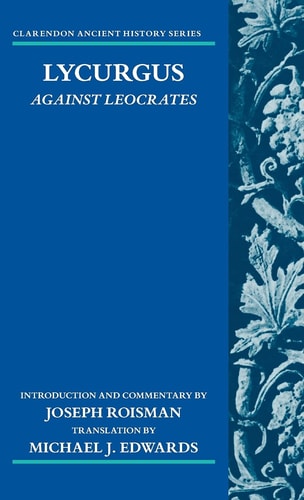
Lycurgus: Against Leocrates
0
0
As an Amazon Associate and affiliate partner, Menrva Books earns from qualifying purchases. Learn more
Author Description
This volume provides readers with a new translation and up to date historical and rhetorical commentary on the only extant speech of the Athenian leader Lycurgus (390s/380s-324 BCE), one of Athens' most influential statesman and orators. His prosecutorial speech, Against Leocrates, delivered in 330 BCE, indicted his compatriot for treason, claiming that he fled Athens after the battle of Chaeronea when the city was under threat of attack by Philip II of Macedonia, though this attack never materialized.Although Leocrates was acquitted after the evenly split jury ultimately came down in favour of the defence, the speech is much more than a condemnation of an alleged misconduct: it provides valuable information on the historical and political events around Chaeronea and offers Lycurgus' vision of what Athens could and should do in those circumstances, in light of models which he fashioned from Athenian and other Greek mythical and historical pasts. Not only his legal and rhetorical strategies and the merits of the case are examined here, but also what the speech tells us about his and his contemporaries' perceptions of patriotism, their religious beliefs, views of desirable citizenship, and the tensions between the individual and the state. A detailed introduction complements the new English translation of the speech with an authoritative account of its history and manuscript tradition, as well as an overview of the trial's procedure, Lycurgus' motives for initiating it, and Leocrates' defence. It also provides a survey of Athenian democracy and judicial system in the late fourth century BCE which will be invaluable for readers new to the text, covering Lycurgus' career, his ideology and program for Athens, and what these meant to individual Athenians and democracy, while the in-depth commentary analysing the historical, legal, and rhetorical facets of this multi-layered and unique oration will be of use to both students and advanced scholars of ancient Greek history.
Menrva's Summary
THE THESIS
This volume investigates the historical, legal, and rhetorical significance of Lycurgus's speech 'Against Leocrates' to understand the political climate and civic values of fourth-century BCE Athens. Joseph Roisman, a scholar of ancient Greek history, utilizes the text of the only surviving speech by the Athenian statesman Lycurgus to reconstruct the events surrounding the battle of Chaeronea. By analyzing the prosecution of Leocrates for treason, Roisman provides a framework for examining the tensions between individual agency and state loyalty during a period of Macedonian expansion. The work integrates historical context with rhetorical analysis to explain how Lycurgus utilized myth and history to define Athenian patriotism.
THE SCOPE MAP
What You Will Find
- A new English translation of the speech 'Against Leocrates' delivered in 330 BCE.
- Historical and rhetorical commentary on Athenian judicial procedures and legal strategy.
- Analysis of late fourth-century BCE Athenian democracy and political ideology.
- Examination of contemporary perceptions regarding citizenship, religious belief, and the state.
THE AUTHORITY PERSPECTIVE
Scholars and students of ancient Greek history frequently cite this volume as a foundational resource for understanding the intersection of law and politics in the late fourth century BCE. The text is noted for its accessibility to newcomers while providing the analytical depth required for advanced academic research.
Page Count:
288
Publication Date:
2019-06-04
Publisher:
Oxford University Press
ISBN-10:
0198830173
ISBN-13:
9780198830177
History
Biography
Ancient History
Law
Community Tags
Similar Books