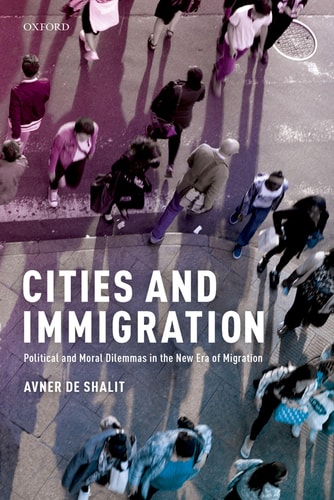
Cities and Immigration: Political and Moral Dilemmas in the New Era of Migration
0
0
As an Amazon Associate and affiliate partner, Menrva Books earns from qualifying purchases. Learn more
Author Description
All over the world immigration is one of the most urgent political issues, creating tensions and unrest as well as questions of justice and fairness. Academics as well as politicians have been relating to the question of how states should cope with immigrants; but 96% of immigrants end up in cities, and in Europe and the USA, two thirds of the immigrants settle in seven or eight cities. Indeed, most of us encounter with immigrants as city-zens, in our everyday life, rather than as citizens of states. So how should cities integrate immigrants? Should cities be allowed to design their autonomous integration policies? Could they issue visas and permits to immigrants? Should immigrants be granted voting rights in local elections before naturalization? And how do cities think about these issues? What can we learn from cities which are thought to be successful in integrating and assimilating immigrants? Is there a model of integration within the city which is best?The book discusses these questions both empirically and normatively. The book is based on hundreds of in depth discussions of these matters with city dwellers in San Francisco, New York, London, Amsterdam, Berlin, Thessaloniki and Jerusalem. It shifts the discourse on immigration from 'thinking like a state' to 'thinking like a city'.
Menrva's Summary
THE THESIS
This book investigates how the focus of immigration policy should shift from the nation-state level to the urban level to better address the practical and moral challenges of integration. Avner de-Shalit, a political theorist, utilizes his research to argue that because the vast majority of immigrants settle in major metropolitan areas, cities possess a unique capacity and responsibility to manage integration. By moving away from state-centric models, the author proposes a framework that prioritizes the lived experience of city dwellers and the specific administrative capabilities of local governments.
THE SCOPE MAP
What You Will Find
- Comparative analysis of immigration integration policies in seven major global cities including New York, London, and Berlin.
- Normative arguments regarding local voting rights, autonomous integration policies, and municipal visa authority.
- Qualitative data derived from hundreds of in-depth interviews with diverse city residents.
- A theoretical framework for transitioning from state-level immigration discourse to city-level governance.
THE AUTHORITY PERSPECTIVE
Experts in urban studies and political science recognize this work as a significant contribution to the decentralization of migration policy debates. Readers frequently note the accessible yet rigorous nature of the author's normative arguments regarding the role of the city in modern democracy.
Page Count:
192
Publication Date:
2019-02-06
Publisher:
Oxford University Press
ISBN-10:
0198833210
ISBN-13:
9780198833215
Immigrants
Immigration
Public Policy
Urban Studies
Sociology
Cities And Towns
Community Tags
Similar Books