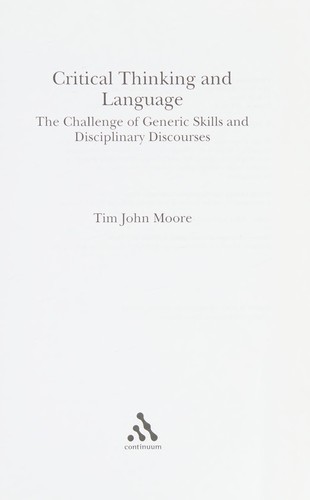
Critical Thinking and Language
0
0
As an Amazon Associate and affiliate partner, Menrva Books earns from qualifying purchases. Learn more
Author Description
This book clarifies the idea of critical thinking by investigating the 'critical' practices of academics across a range of disciplines. Drawing on key theorists - Wittgenstein, Geertz, Williams, Halliday - and using a 'textographic' approach, the book explores how the concept of critical thinking is understood by academics and also how it is constructed discursively in the texts and practices they employ in their teaching. Critical thinking is one of the most widely discussed concepts in debates on university learning. For many, the idea of teaching students to be critical thinkers characterizes more than anything else the overriding purpose of 'higher education'. But whilst there is general agreement about its importance as an educational ideal, there is surprisingly little agreement about what the concept means exactly. Also at issue is how and what students need to be taught in order to be properly critical in their field. This searching monograph seeks answers to these important questions.
Menrva's Summary
THE THESIS
This book investigates the elusive concept of critical thinking within academic disciplines and its discursive construction in teaching practices. The author, Tim John Moore, draws on theorists such as Wittgenstein, Geertz, Williams, and Halliday, employing a 'textographic' approach to explore how academics understand and implement critical thinking. The work addresses the widespread agreement on critical thinking's importance in higher education, contrasted with a significant lack of consensus on its precise meaning and effective pedagogical methods. This monograph seeks to provide answers to these pressing questions concerning the nature and teaching of critical thought in academic fields.
THE SCOPE MAP
- Analysis of critical thinking practices across diverse academic disciplines.
- Exploration of key theorists including Wittgenstein, Geertz, Williams, and Halliday.
- Application of a 'textographic' approach to study academic discourse.
- Examination of how academics understand and construct critical thinking.
- Investigation into the discursive construction of critical thinking in teaching texts and practices.
- Discussion on the role of critical thinking as a central ideal in university learning.
- Addressing the ambiguity surrounding the exact meaning of 'critical thinking' in higher education.
- Exploring the pedagogical challenges of teaching students to be effectively critical within their fields.
THE AUTHORITY PERSPECTIVE
The book is positioned as a searching monograph that delves into the complexities of critical thinking in higher education. It aims to clarify a widely discussed but poorly defined concept, drawing on significant theoretical frameworks and a specific methodological approach. The work is likely to appeal to academics, educators, and researchers interested in the philosophy of education, linguistics, and pedagogical theory. Its focus on discursive construction and academic practice suggests a text that will engage with scholarly debates on learning and knowledge production.
Page Count:
247
Publication Date:
2011-01-01
ISBN-10:
1441157506
ISBN-13:
9781441157508
Literary Fiction
Non-Fiction
Philosophy
Pedagogy
Critical thinking
Higher Education
Linguistics
Community Tags
Similar Books