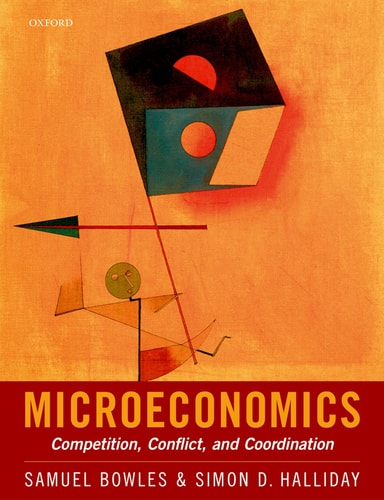
Microeconomics: Competition, Conflict, and Coordination
0
0
As an Amazon Associate and affiliate partner, Menrva Books earns from qualifying purchases. Learn more
Author Description
Bowles and Halliday capture the intellectual excitement, analytical precision, and policy relevance of the new microeconomics that has emerged over the past decades. Drawing on themes of the classical economists from Smith through Marx and 20th century writers - including Hayek, Coase, and Arrow - the authors use twenty-first century analytical methods to address enduring challenges in economics.The subtitle of the work - Competition, conflict, and coordination - signals their focus on how the institutions of a modern capitalist economy work, introducing students to recent developments in the microeconomics of credit and labor markets with asymmetric information, a dynamic analysis of how firms compete going beyond price taking, as well as bargaining over the gains from exchange, social norms, and the exercise of power.The new benchmark model proposed by Bowles and Halliday is based on an empirical approach to economic actors and problems. They start from the premise that contracts are incomplete, and that as a result market failures, rather than being a special case illustrated by environmental spillovers, are to be expected in markets for labor, credit, knowledge and throughout the economy. They explain how experiments show that human motivations include ethical as well as other-regarding preferences (rather than entirely self-interested) and explain why the technologies of knowledge-based economies are a source of winner-take-all rather than stable competition. The authors also consider the intrinsic limits of mechanism design and governmental interventions in the economy.Teaching recent developments in microeconomic theory allows the authors to provide students with the tools to analyze and engage in informed debate on the issues that concern them most: climate change, inequality, innovation, and epidemic spread. Tradeoffs are highlighted by providing models in which capitalism can be seen as an "innovation machine" that raises material living standards on avera
Menrva's Summary
THE THESIS
This book investigates how modern capitalist economies function by integrating classical economic thought with contemporary analytical methods to address market failures and institutional dynamics. The authors, Samuel Bowles and Simon D. Halliday, utilize an empirical framework that challenges traditional models of self-interested actors. By focusing on incomplete contracts and asymmetric information, they argue that market failures are systemic rather than exceptional, necessitating a reevaluation of how credit, labor, and knowledge markets operate in the twenty-first century.
THE SCOPE MAP
What You Will Find
- Analysis of credit and labor markets characterized by asymmetric information and incomplete contracts.
- Empirical evidence regarding human motivations, including ethical and other-regarding preferences.
- Examination of winner-take-all dynamics in knowledge-based economies.
- Theoretical models addressing climate change, inequality, innovation, and epidemic spread.
THE AUTHORITY PERSPECTIVE
Experts identify this text as a significant departure from traditional microeconomic curricula, favoring an empirical, institution-focused approach. Readers frequently note the academic density of the prose, which serves as a rigorous foundation for students engaging with complex contemporary economic policy debates.
Page Count:
1072
Publication Date:
2022-10-29
Publisher:
Oxford University Press
ISBN-10:
0198843208
ISBN-13:
9780198843207
Economics
Capitalism
Academic
Microeconomics
textbook
Community Tags
Similar Books