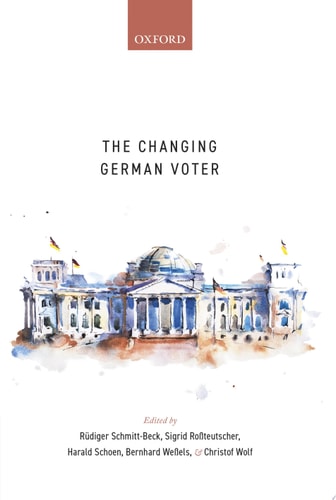
The Changing German Voter
0
0
As an Amazon Associate and affiliate partner, Menrva Books earns from qualifying purchases. Learn more
Author Description
This is an open access title available under the terms of a CC BY-NC-ND 4.0 International licence. It is free to read at Oxford Scholarship Online and offered as a free PDF download from OUP and selected open access locations.Over the past half century, the behavior of German voters has changed profoundly - at first rather gradually, but during the last decade at accelerated speed. Electoral decision-making has become much more volatile, rendering election outcomes less predictable. Party system fragmentation intensified sharply. The success of the AfD put an end to Germany's exceptionality as one of the few European countries without a strong right-wing populist party. Utilizing a wide range of data compiled by the German Longitudinal Election Study, the book examines changing voters' behavior in the context of changing parties, campaigns, and media during the period of its hitherto most dramatically increased fluidity at the 2009, 2013, and 2017 federal elections. Guided by the notions of realignment and dealignment the study addresses three questions: How did the turbulences that increasingly characterize German electoral politics come about? How did they in turn condition voters' decision-making? How were voters' attitudes and choices affected by situational factors that pertained to the specifics of particular elections? The Changing German Voter demonstrates how traditional cleavages lost their grip on voters and a new socio-cultural line of conflict became the dominant axis of party competition. A series of major crises, but also programmatic shifts of the established parties promoted this development. It led to a segmentation of the party system that pits the right-wing populist AfD against the traditional parties. The book also demonstrates the relevance of coalition preferences, candidate images as well as media and campaign effects for voters' attitudes, beliefs, and preferences.
Menrva's Summary
THE THESIS
This study investigates the fundamental shifts in German electoral behavior and the resulting fragmentation of the party system over the last decade. The authors, a team of prominent political scientists, utilize extensive longitudinal data to analyze how traditional voter alignments have dissolved in favor of a new socio-cultural conflict axis. By examining the 2009, 2013, and 2017 federal elections, the text provides a rigorous framework for understanding the rise of right-wing populism and the increased volatility of the German electorate.
THE SCOPE MAP
What You Will Find
- Longitudinal analysis of German federal elections from 2009 to 2017.
- Empirical data derived from the German Longitudinal Election Study.
- Examination of the impact of media, campaign strategies, and candidate imagery on voter decision-making.
- Theoretical application of realignment and dealignment models to modern European political systems.
THE AUTHORITY PERSPECTIVE
Experts recognize this work as a definitive quantitative analysis of contemporary German political shifts. Scholars frequently cite the text for its methodological rigor and its comprehensive use of longitudinal data to explain the decline of traditional party dominance.
Page Count:
416
Publication Date:
2022-10-31
Publisher:
Oxford University Press
ISBN-10:
0198847513
ISBN-13:
9780198847519
Sociology
Germany
Government
Public opinion
Elections
Community Tags
Similar Books






Reader Comments
Share Your Thoughts
No comments yet. Be the first to share your thoughts!