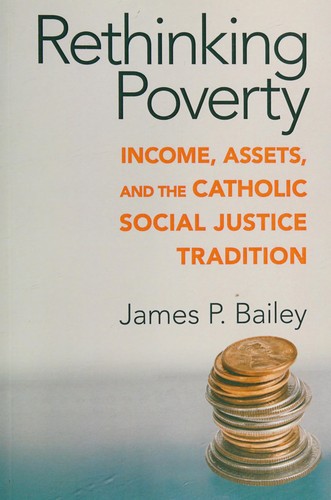
Rethinking Poverty
0
0
As an Amazon Associate and affiliate partner, Menrva Books earns from qualifying purchases. Learn more
Author Description
In this work the author argues that most contemporary policies aimed at reducing poverty in the United States are flawed because they focus solely on insufficient income. He contends that traditional policies such as minimum wage laws, food stamps, housing subsidies, earned income tax credits, and other forms of cash and non cash income supports need to be complemented by efforts that enable the poor to save and accumulate assets. Drawing on Michael Sherraden's work on asset building and scholarship by Melvin Oliver, Thomas Shapiro, and Dalton Conley on asset discrimination, the author presents us with a novel and promising way forward to combat persistent and morally unacceptable poverty in the United States and around the world. This book makes use of a significant body of Catholic social teachings in its argument for an asset development strategy to reduce poverty. These Catholic teachings include, among others, principles of human dignity, the social nature of the person, the common good, and the preferential option for the poor. These principles and the related social analyses have not yet been brought to bear on the idea of asset building for the poor by those working within the Catholic social justice tradition. This book redresses this shortcoming, and further, claims that a Catholic moral argument for asset building for the poor can be complemented and enriched by Martha Nussbaum's "capabilities approach." This book will affect current debates and practical ways to reduce poverty, as well as the future direction of Catholic social teaching.
Menrva's Summary
THE THESIS
This work challenges prevailing anti-poverty policies by arguing that they are fundamentally flawed due to their narrow focus on income alone. The author contends that traditional support systems like minimum wage laws, food stamps, and tax credits are insufficient and must be augmented by strategies that enable the poor to save and accumulate assets. Drawing on established scholarship in asset building and asset discrimination, the book proposes a novel approach to combatting persistent poverty. It uniquely integrates Catholic social teachings, emphasizing principles of human dignity and the common good, to advocate for asset development as a moral imperative.
THE SCOPE MAP
- Critique of contemporary US anti-poverty policies focusing on income insufficiency.
- Argument for complementing income support with asset accumulation strategies.
- Integration of Michael Sherraden's asset-building framework.
- Discussion of scholarship by Oliver, Shapiro, and Conley on asset discrimination.
- Application of Catholic social teachings (human dignity, social nature, common good, preferential option for the poor) to asset development.
- Exploration of Martha Nussbaum's 'capabilities approach' in relation to asset building.
- Analysis of how asset development can inform future Catholic social justice initiatives.
THE AUTHORITY PERSPECTIVE
The book is positioned as a significant contribution to both policy debates and the discourse within Catholic social teaching. Its novel approach of linking asset building with established Catholic principles is highlighted as a key innovation. The work aims to influence current strategies for poverty reduction and shape the future direction of social justice advocacy within the Catholic tradition. By bridging economic policy with theological ethics, it seeks to offer a more comprehensive and morally grounded path forward.
Page Count:
176
Publication Date:
2010-01-01
ISBN-10:
0268022232
ISBN-13:
9780268022235
Non-Fiction
Economics
Politics
Social policy
Catholic Social Teaching
Community Tags
Similar Books