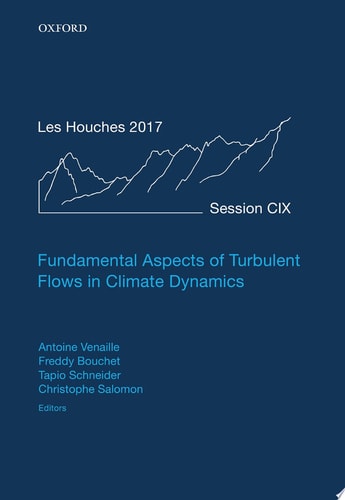
Fundamental Aspects of Turbulent Flows in Climate Dynamics: Lecture Notes of the Les Houches Summer School
0
0
As an Amazon Associate and affiliate partner, Menrva Books earns from qualifying purchases. Learn more
Author Description
This volume, number 109 of the Les Houches Summer School series, presents the lectures held in August 2017 on the subject of turbulent flows in climate dynamics.Leading scientists in the fields of climate dynamics, atmosphere and ocean dynamics, geophysical fluid dynamics, physics and non-linear sciences present their views on this fast growing and interdisciplinary field of research, by venturing upon fundamental problems of atmospheric convection, clouds, large scale circulation, and predictability.Climate is controlled by turbulent flows. Turbulent motions are responsible for the bulk of the transport of energy, momentum, and water vapor in the atmosphere, which determine the distribution of temperature, winds, and precipitation on Earth. The aim of this book is to survey what is known about how turbulent flows control climate, what role they may play in climate change, and to outline where progress in this important area can be expected, given today's computational and observational capabilities.This book reviews the state-of-the-art developments in this field and provides an essential background to future studies. All chapters are written from a pedagogical perspective, making the book accessible to masters and PhD students and all researchers wishing to enter this field.
Menrva's Summary
THE THESIS
This volume investigates the fundamental mechanisms by which turbulent flows govern the Earth's climate system and influence long-term climate variability. The authors, a collection of leading experts in geophysical fluid dynamics and atmospheric physics, synthesize current research to explain how turbulent motions dictate the transport of energy, momentum, and moisture. By bridging the gap between theoretical physics and observational climate data, the text provides a rigorous framework for understanding the role of turbulence in atmospheric and oceanic circulation.
THE SCOPE MAP
What You Will Find
- Theoretical foundations of atmospheric convection and large-scale circulation patterns.
- Analysis of energy and moisture transport mechanisms within the atmosphere and oceans.
- Pedagogical reviews of state-of-the-art developments in geophysical fluid dynamics.
- Discussion on the predictability of climate systems in the context of modern computational capabilities.
THE AUTHORITY PERSPECTIVE
Experts identify this collection as a foundational resource for graduate-level students and researchers entering the field of climate dynamics. Readers frequently note the high academic density of the prose, which effectively bridges the gap between complex fluid physics and practical climate modeling.
Page Count:
256
Publication Date:
2020-03-05
Publisher:
Oxford University Press
ISBN-10:
0198855214
ISBN-13:
9780198855217
Science
Fluid dynamics
Oceanography
Meteorology
Physics
Community Tags
Similar Books