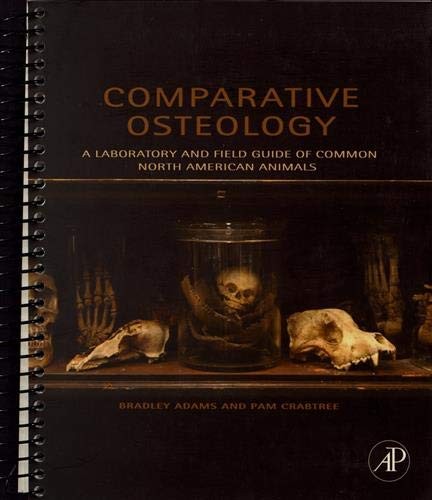
Comparative Osteology
0
0
As an Amazon Associate and affiliate partner, Menrva Books earns from qualifying purchases. Learn more
Author Description
In the forensic context it is quite common for nonhuman bones to be confused with human remains and end up in the medical examiner or coroner system. It is also quite common for skeletal remains (both human and nonhuman) to be discovered in archaeological contexts. While the difference between human and nonhuman bones is often very striking, it can also be quite subtle. Fragmentation only compounds the problem. The ability to differentiate between human and nonhuman bones is dependent on the training of the analyst and the available reference and/or comparative material. Comparative Osteology is a photographic atlas of common North American animal bones designed for use as a laboratory and field guide by the forensic scientist or archaeologist. The intent of the guide is not to be inclusive of all animals, but rather to present some of the most common species which also have the highest likelihood of being potentially confused with human remains.
Menrva's Summary
THE THESIS
The ability to distinguish human from nonhuman skeletal remains is critical in forensic and archaeological contexts, yet subtle differences and fragmentation often complicate identification. This photographic atlas addresses the common challenge of misidentifying nonhuman bones as human within the medical examiner or coroner system, or discovering mixed remains in archaeological sites. It focuses on common North American animal species most likely to be confused with human remains, providing a visual reference for analysts. The guide aims to equip forensic scientists and archaeologists with the necessary training and comparative material to accurately differentiate species.
THE SCOPE MAP
- Photographic atlas of common North American animal bones.
- Detailed images to aid in differentiating human from nonhuman skeletal remains.
- Focus on species with the highest potential for confusion with human remains.
- Laboratory and field guide utility for forensic scientists and archaeologists.
- Identification of subtle osteological differences.
- Guidance on interpreting fragmented skeletal material.
THE AUTHORITY PERSPECTIVE
This guide is designed as a practical tool for professionals in forensic science and archaeology, addressing a specific and common challenge in their fields. Its utility lies in its focused selection of species and detailed photographic comparisons, aiming to enhance the accuracy of skeletal identification. The book's value is derived from its direct applicability to real-world scenarios where distinguishing between human and animal remains is paramount for accurate casework and research.
Page Count:
443
Publication Date:
2012-01-01
ISBN-10:
0123884373
ISBN-13:
9780123884374
Non-Fiction
Science
Reference
Forensic Science
Anatomy
Archaeology
Zoology
Community Tags
Similar Books