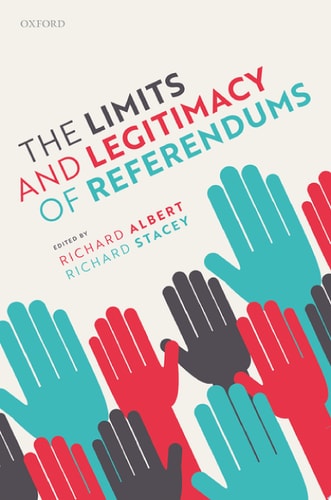
The Limits and Legitimacy of Referendums
0
0
As an Amazon Associate and affiliate partner, Menrva Books earns from qualifying purchases. Learn more
Author Description
The possibility of democracy-enhancing uses and anti-democratic abuses of referendums reveals a paradox: mechanisms of democracy can be exploited to do violence to the basic principles of democracy. The Limits and Legitimacy of Referendums seeks to identify standards we might use to assess the democratic legitimacy of a referendum when we cannot rely on the norms of traditional liberal democracy.This innovative book explores how referendums manage the tension between liberalism and democracy, and whether this device holds promise for reconciling these two commitments. A range of scholars from around the world expose how referendums may be abused on one hand to achieve short-term political or even personal gains, and how, on the other, they may aspire to reflect the best traditions of deliberative, innovative, democracy-enhancing popular decision-making.Structured around three big questions, this book seeks to identify what makes a referendum legitimate. First, why have referendums on issues of fundamental political importance become so frequent around the world? Second, who are - or who should be - the people that make decisions about a political community's future? And third, are referendums an effective and reliable mechanism of popular sovereignty or democratic choice?These essays - written for scholars, public lawyers, political actors and citizens - bring together diverse perspectives on referendums, constitutionalism, liberalism and democracy in ways that challenge the conventional wisdom, prompt new answers to enduring questions, and urge reconsideration of how we evaluate the legitimacy of referendums.
Menrva's Summary
THE THESIS
This book investigates the inherent paradox of referendums, questioning how mechanisms designed to enhance democracy can simultaneously be exploited to undermine its fundamental principles. Edited by Richard Albert and Richard Stacey, the text compiles essays from a global cohort of scholars to establish normative standards for assessing the legitimacy of referendums. By examining the tension between liberalism and democratic practice, the authors provide a framework for evaluating whether popular voting devices effectively serve the public interest or merely facilitate political manipulation.
THE SCOPE MAP
What You Will Find
- Comparative analysis of global referendum trends and their frequency in modern political systems.
- Theoretical frameworks for defining the 'people' in the context of popular sovereignty and community decision-making.
- Critical evaluation of referendums as tools for both deliberative democracy and short-term political gain.
- Interdisciplinary perspectives bridging constitutional law, political theory, and democratic governance.
THE AUTHORITY PERSPECTIVE
Experts identify this collection as a significant contribution to the study of constitutional design and democratic legitimacy. Readers frequently note the academic density of the prose, which serves as a rigorous resource for public lawyers, political actors, and scholars of governance.
Page Count:
320
Publication Date:
2022-10-31
Publisher:
Oxford University Press
ISBN-10:
0198867646
ISBN-13:
9780198867647
Law
Political Theory
Constitutional Law
Government
Democracy
Community Tags
Similar Books