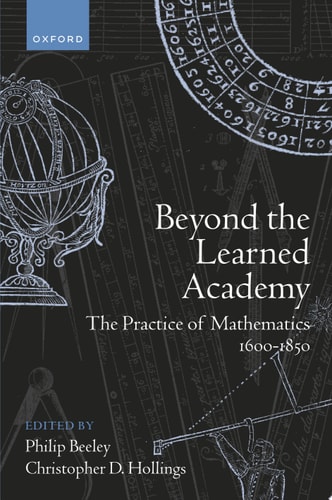
Beyond the Learned Academy: The Practice of Mathematics, 1600-1850
0
0
As an Amazon Associate and affiliate partner, Menrva Books earns from qualifying purchases. Learn more
Author Description
The tremendous growth of the mathematical sciences in the early modern world was reflected contemporaneously in an increasingly sophisticated level of practical mathematics in fields such as merchants' accounts, instrument making, teaching, navigation, and gauging. In many ways, mathematics shaped the knowledge culture of the age, infiltrating workshops, dockyards, and warehouses, before extending through the factories of the Industrial Revolution to the trading companies and banks of the nineteenth century.While theoretical developments in the history of mathematics have been made the topic of numerous scholarly investigations, in many cases based around the work of key figures such as Descartes, Huygens, Leibniz, or Newton, practical mathematics, especially from the seventeenth century onwards, has been largely neglected.The present volume, comprising fifteen essays by leading authorities in the history of mathematics, seeks to fill this gap by exemplifying the richness, diversity, and breadth of mathematical practice from the seventeenth century through to the middle of the nineteenth century.
Menrva's Summary
THE THESIS
This volume investigates the historical evolution and societal integration of practical mathematics between 1600 and 1850, arguing that applied mathematical knowledge was as significant to the era's development as theoretical breakthroughs. Editors Christopher Hollings and Philip G. Beeley assemble a collection of fifteen essays by leading historians to examine how mathematical practice permeated diverse sectors, including commerce, navigation, and industrial manufacturing. By shifting the focus away from canonical figures like Newton and Leibniz, the authors provide a comprehensive framework for understanding how mathematics functioned as a tool for economic and technical progress during the early modern period.
THE SCOPE MAP
What You Will Find
- Analysis of mathematical applications in merchant accounting, instrument making, and navigation.
- Examination of the transition from workshop-based mathematics to industrial-scale application.
- Case studies detailing the role of mathematics in the development of trading companies and banking institutions.
- Historical evidence demonstrating the infiltration of mathematical knowledge into the culture of the Industrial Revolution.
THE AUTHORITY PERSPECTIVE
Experts recognize this collection as a significant contribution to the history of science, specifically for its focus on the often-overlooked practical dimensions of mathematical history. Readers frequently note the academic density of the prose and the rigorous archival research presented by the contributing scholars.
Page Count:
512
Publication Date:
2024-01-01
Publisher:
Oxford University Press
ISBN-10:
0198863950
ISBN-13:
9780198863953
History
Science
Non-Fiction
Mathematics
Community Tags
Similar Books