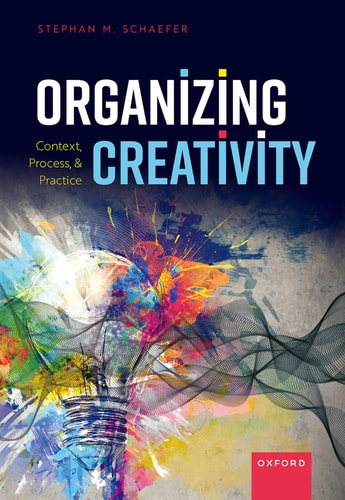
Organizing Creativity: Context, Process, and Practice
0
0
As an Amazon Associate and affiliate partner, Menrva Books earns from qualifying purchases. Learn more
Author Description
Creativity is a defining feature of contemporary work life. Who has not taken part in brainstorming sessions, read glossy pamphlets about innovation and creativity as important cornerstones of a new business strategy, or been made aware of the importance of creative skills for one´s career? But what does it mean to be creative in and as an organization?Organizing Creativity provides an answer to this question. The book builds on the premise that creativity is essentially about ideas. Every organization is dependent on valuable ideas for solving everyday problems as well as inventing new processes, products or services. The main argument of the book is that an analysis of organizational creativity should always account for the interdependency of context, process and practice. Based on cultural and processual perspectives, it highlights the implications of context, process and practice for different aspects of the creative process: generating, evaluating and facilitating ideas. Furthermore, it reflects on how dominant notions of creativity in the economy and society prevent transformative changes and suggests a radical transformative approach to organizing creativity as an alternative.To support and illustrate its argument, Organizing Creativity draws on abundant empirical examples, case illustrations and seminal research from Sociology, Social Psychology and Organization Studies. It provides us with a multi-dimensional perspective and will both further our understanding of and spark critical reflection on the complex interplay of the organizational, social and cultural contexts, processes and practices of organizing creativity.
Menrva's Summary
THE THESIS
This book investigates how organizations can effectively foster and manage creativity by analyzing the complex interdependency of context, process, and practice. Stephan M. Schaefer draws upon cultural and processual perspectives to argue that creativity is fundamentally about the generation, evaluation, and facilitation of ideas within a structured environment. By integrating research from sociology, social psychology, and organization studies, the author challenges dominant economic notions of creativity and proposes a more radical, transformative approach to organizational design. The text serves as a framework for understanding how social and cultural factors dictate the success or failure of creative initiatives in the workplace.
THE SCOPE MAP
What You Will Find
- An analysis of the interplay between organizational context, internal processes, and daily practices.
- A critical examination of how current economic models of creativity often stifle genuine innovation.
- Empirical case studies and illustrations drawn from sociology and social psychology.
- A proposed methodology for shifting from traditional brainstorming to a transformative approach to idea management.
THE AUTHORITY PERSPECTIVE
Experts in organizational studies view this text as a rigorous academic exploration of the social dimensions of innovation. Readers frequently note the scholarly density of the prose, which makes it a suitable resource for researchers and practitioners interested in the sociological foundations of business strategy.
Page Count:
224
Publication Date:
2024-01-01
Publisher:
Oxford University Press
ISBN-10:
0198864140
ISBN-13:
9780198864141
Business
Sociology
Strategic Planning
Creativity
Innovation
Management
Community Tags
Similar Books