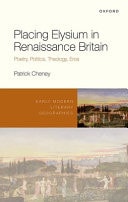
Placing Elysium in Renaissance Britain: Poetry, Politics, Theology, Eros
0
0
As an Amazon Associate and affiliate partner, Menrva Books earns from qualifying purchases. Learn more
Author Description
Placing Elysium In Renaissance Britain: Poetry, Politics, Theology, Eros Is The First Study Of Elysium As A Place In English Renaissance Culture. The Absence Of Such A Study In The Fields Of Literature And Geography Is Surprising: From Its Captivating Origin In The Oceanic Margins Of Homer's Odyssey To Its Presence In The Eden Of Milton's Paradise Lost, Elysium Is A Destination To Be Desired: It Is The Land Of The Blessed. In Such A Project, Elysium Becomes A Geographical Site For An Author's Most Valued Space. In Britannia, Camden Provides Leadership For This Project By Drawing On Plutarch, Who Locates Elysium In Britain. Following Camden, Spenser Centralizes The Idea Of Britain As Elysium. Following Spenser, English Authors Make The Elysian Place The Site Of A Liberating Sublimity As The Height Of Artistic Renown. This Authorial Template Becomes The Site For Literary Inflections In The Realms Of Politics, Theology, And Eros. However, Kyd And Marlowe Darken The Spenserian Project, Recalling Virgil's Geographical Positioning Of Elysium Next To Hell. In Turn, Drayton, Chapman, And Marston Champion The Spenserian Idea Of Britain As Elysium. As This Network Suggests, English Authors Make Elysium The Central Place Of The 'renaissance' Period Concept, And They Do So In The Nation-building Genre Of Epic. In The Muses Elizium, Drayton Crowns The Spenserian Tradition By Making The Blessed Place The Monomyth Of National Poetry. At The Centre Of The Monomyth Is The Cherished Ideal Of Renaissance Culture: The Elysian Capacity Of The Human To Become Divine
Menrva's Summary
THE THESIS
This study investigates the conceptual and geographical evolution of Elysium within English Renaissance literature, arguing that authors utilized the mythic space to define national identity and artistic ambition. Patrick Cheney, a scholar of early modern literature, synthesizes classical sources with British topographical history to demonstrate how writers from Spenser to Milton transformed the classical afterlife into a site of political, theological, and erotic significance. The work posits that the construction of Britain as a terrestrial Elysium served as a foundational project for the period's epic poetry and national self-conception.
THE SCOPE MAP
What You Will Find
- Analysis of the transition of Elysium from Homeric myth to a localized British landscape.
- Examination of the influence of William Camden and Edmund Spenser on the nationalization of the Elysian ideal.
- Comparative study of the darker, Virgilian interpretations of Elysium presented by Thomas Kyd and Christopher Marlowe.
- Exploration of the intersection between human divinity, epic genre conventions, and Renaissance theological discourse.
THE AUTHORITY PERSPECTIVE
Scholars identify this work as a significant contribution to the field of early modern literary geography, noting its rigorous synthesis of classical reception and nationalistic myth-making. The text is recognized for its dense, academic prose that provides a comprehensive framework for understanding how Renaissance authors mapped their cultural aspirations onto the British landscape.
Page Count:
336
Publication Date:
2026-01-02
Publisher:
Oxford University Press
ISBN-10:
0198871201
ISBN-13:
9780198871200
Poetry
History
Criticism & Theory
Geography
Literary Criticism
Theology
Community Tags
Similar Books