Picturing the Cosmos
0
0
As an Amazon Associate and affiliate partner, Menrva Books earns from qualifying purchases. Learn more
Author Description
The vivid, dramatic images of distant stars and galaxies taken by the Hubble Space Telescope have come to define how we visualize the cosmos. In their immediacy and vibrancy, photographs from the Hubble show what future generations of space travelers might see should they venture beyond our solar system. But their brilliant hues and precise details are not simply products of the telescope's unprecedented orbital location and technologically advanced optical system. Rather, they result from a series of deliberate decisions made by the astronomers who convert raw data from the Hubble into spectacular pictures by assigning colors, adjusting contrast, and actively composing the images, balancing the desire for an aesthetically pleasing representation with the need for a scientifically valid one.In Picturing the Cosmos, Elizabeth A. Kessler examines the Hubble's deep space images, highlighting the remarkable resemblance they bear to nineteenth-century paintings and photographs of the American West and their invocation of the visual language of the sublime. Drawing on art history and the history of science, as well as interviews with astronomers who work on the Hubble Heritage Project, Kessler traces the ways that the sublime, with its inherent tension between reason and imagination, not only forms the appearance of the images, but also operates on other levels. The sublime informs the dual expression--numeric and pictorial--of digital data and underpins the relevance of the frontier for a new era of exploration performed by our instruments rather than our bodies. Through their engagement with the sublime the Hubble images are a complex act of translation that encourages an experience of the universe as simultaneously beyond humanity's grasp and within the reach of our knowledge.Strikingly illustrated with full-color images, this book reveals the scientific, aesthetic, and cultural significance of the Hubble pictures, offering a nuanced understanding of how they shape ou
Menrva's Summary
THE THESIS
The Hubble Space Telescope's iconic images, while appearing to offer direct views of the cosmos, are in fact carefully constructed representations. Elizabeth A. Kessler's book delves into the artistic and scientific processes behind these images, revealing how astronomers transform raw data into visually compelling pictures. The book explores the tension between scientific validity and aesthetic appeal, examining how color, contrast, and composition are manipulated. Kessler draws parallels between Hubble images and 19th-century landscape paintings, particularly their evocation of the sublime, and investigates how this concept informs both the visual language and the cultural relevance of cosmic exploration.
THE SCOPE MAP
- Analysis of Hubble Space Telescope deep space images and their aesthetic qualities.
- Exploration of the historical connections between cosmic imagery and 19th-century landscape art, especially the concept of the sublime.
- Examination of the role of astronomers in data translation, including color assignment, contrast adjustment, and image composition.
- Discussion of the dual nature of scientific representation: balancing aesthetic appeal with scientific accuracy.
- Interviews with astronomers involved in the Hubble Heritage Project.
- Investigation into how the sublime informs the visual and numeric expression of digital data.
- Analysis of the frontier narrative in the context of robotic space exploration.
- Consideration of the cultural significance and interpretation of Hubble images.
THE AUTHORITY PERSPECTIVE
In The Authority Perspective, this book is recognized for its interdisciplinary approach, bridging art history and the history of science to analyze the visual culture of astronomy. Scholars likely appreciate Kessler's detailed examination of the aesthetic choices made in producing Hubble images and her insightful connection to the historical concept of the sublime. The book is expected to offer a nuanced understanding of how these images shape our perception of the universe, highlighting both its vastness and our capacity to comprehend it.
Page Count:
279
Publication Date:
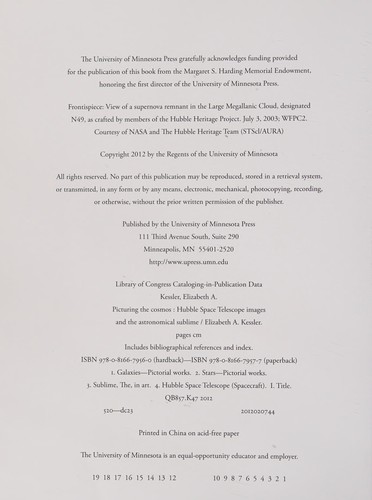
2012-01-01
ISBN-10:
0816679568
ISBN-13:
9780816679560
Non-Fiction
Art
Science
Astronomy
Visual Culture
Art History
Community Tags
Similar Books