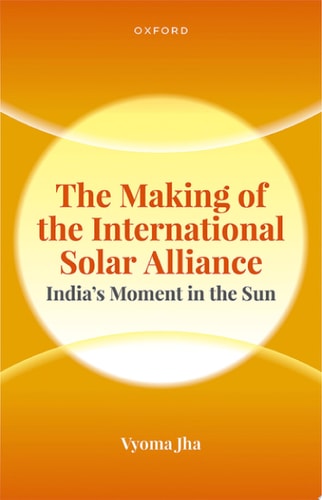
The Making of the International Solar Alliance: India's Moment in the Sun
0
0
As an Amazon Associate and affiliate partner, Menrva Books earns from qualifying purchases. Learn more
Author Description
This book is the first empirical account on the making of the International Solar Alliance (ISA). Announced jointly by India and France on the first day of the Paris climate talks in 2015, the ISA was conceived as a coalition of 'solar-rich' countries located between the Tropic of Cancer and the Tropic of Capricorn for optimal absorption of the sun's rays. These 'solar-rich' countries are developing countries that witness almost three hundred sunny days in a year but face major gaps in the deployment of solar energy. In less than two years, the ISA―led by India and backed primarily by developing countries―became a legal entity. With no perceivable competitive advantage in solar manufacturing or technologies, what explains India's relative success in bringing together countries to form a new international organization focused on solar energy? Why did India insist on a treaty structure for the ISA? What are the transaction costs of bringing the 'solar rich' countries vis-à-vis the 'solar poor' countries on board? What was the role of France in the treaty-making process? Responding to these questions, the book draws on the political economy approach to analyse the motivations for India to steer a new treaty-based international organization. It presents the empirical evidence and arguments using three frames: process, politics, and players. Ultimately, the book illustrates a new kind of Indian economic diplomacy, making the ISA the first deliberate instrument of India's foreign policy on climate change and energy.
Menrva's Summary
THE THESIS
This book investigates the strategic motivations and diplomatic processes behind India's leadership in establishing the International Solar Alliance (ISA). Dr. Vyoma Jha utilizes a political economy framework to examine how India successfully navigated the complexities of international treaty-making to create a coalition of solar-rich nations. By analyzing the interplay between national interests and global climate policy, the author argues that the ISA represents a significant evolution in India's economic diplomacy and climate-focused foreign policy.
THE SCOPE MAP
What You Will Find
- An empirical analysis of the treaty-making process for the International Solar Alliance.
- A political economy framework evaluating the motivations of India and France.
- Examination of transaction costs involved in coordinating solar-rich versus solar-poor nations.
- A tripartite analysis focusing on process, politics, and key international players.
THE AUTHORITY PERSPECTIVE
Experts recognize this work as a primary empirical resource for understanding the intersection of Indian foreign policy and global energy governance. Readers frequently note the clarity with which the author dissects the institutional development of the ISA within the broader context of climate diplomacy.
Page Count:
224
Publication Date:
2023-01-01
Publisher:
Oxford University Press
ISBN-10:
0198884702
ISBN-13:
9780198884705
Diplomacy
India
Climate Change
Energy policy
International relations
Community Tags
Similar Books