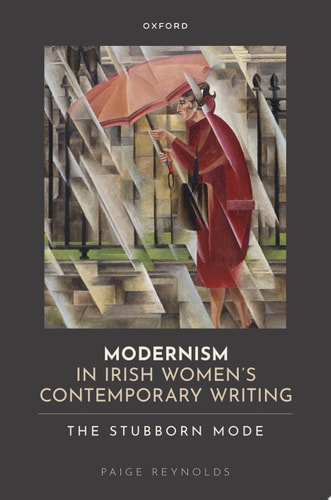
Modernism in Irish Women's Contemporary Writing: The Stubborn Mode
0
0
As an Amazon Associate and affiliate partner, Menrva Books earns from qualifying purchases. Learn more
Author Description
Modernism in Irish Women's Contemporary Writing examines the tangled relationship between contemporary Irish women writers and literary modernism. In the early decades of the twenty-first century, Irish women's fiction has drawn widespread critical acclaim and commercial success, with a surprising number of these works being commended for their innovative redeployment of literary tactics drawn from early twentieth-century literary modernism. But this strategy is not a new one. Across more than a century, writers from Kate O'Brien to Sally Rooney have manipulated and remade modernism to draw attention to the vexed nature of female privacy, exploring what unfolds when the amorphous nature of private consciousness bumps up against external ordering structures in the public world. Living amid the tenaciously conservative imperatives of church and state in Ireland, their female characters are seen to embrace, reject, and rework the ritual of prayer, the fixity of material objects, the networks of the digital world, and the ordered narrative of the book. Such structures provide a stability that is valuable and even necessary for such characters to flourish, as well as an instrument of containment or repression that threatens to, and in some cases does, destroy them. The writers studied here, among them Elizabeth Bowen, Edna O'Brien, Anne Enright, Anna Burns, Claire-Louise Bennett, and Eimear McBride, employ the modernist mode in part to urge readers to recognize that female interiority, the prompt for many of the movement's illustrious formal experiments, continues to provide a crucial but often overlooked mechanism to imagine ways around and through seemingly intransigent social problems, such as class inequity, political violence, and sexual abuse.
Menrva's Summary
THE THESIS
This work investigates how contemporary Irish women writers utilize and adapt the formal tactics of early twentieth-century modernism to navigate the complexities of female interiority and social constraint. Paige Reynolds, a scholar of modernism and Irish literature, analyzes a century of fiction to argue that modernist techniques serve as both a tool for creative expression and a mechanism for critiquing the rigid structures of church and state in Ireland. By examining the intersection of private consciousness and public order, the book demonstrates how these writers employ formal experimentation to address persistent social issues such as class inequity and political violence.
THE SCOPE MAP
What You Will Find
- A longitudinal study spanning from early twentieth-century authors like Elizabeth Bowen to contemporary figures such as Sally Rooney and Anna Burns.
- An analysis of how modernist formal devices, such as stream of consciousness and non-linear narrative, are redeployed in contemporary Irish fiction.
- A thematic exploration of the tension between female privacy and external societal structures like religion, the state, and digital networks.
- A critical framework for understanding how literary form functions as a response to historical and political pressures in the Irish context.
THE AUTHORITY PERSPECTIVE
Scholars and critics recognize this text as a significant contribution to the study of Irish literary history and the evolution of the modernist tradition. Readers frequently note the academic rigor of the prose, which provides a sophisticated lens for understanding the formal innovations of contemporary Irish women writers.
Page Count:
240
Publication Date:
2024-01-01
Publisher:
Oxford University Press
ISBN-10:
0198881053
ISBN-13:
9780198881056
Irish literature
New Used & Rental Textbooks
Modernism
Literary Criticism
British & Irish
Literary History