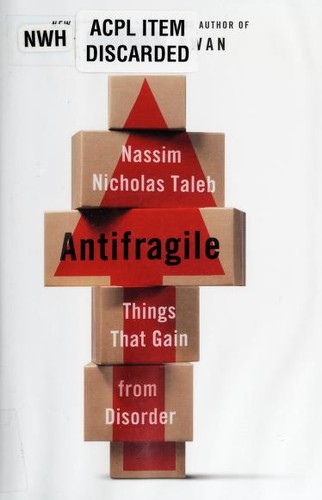
Antifragile
0
0
As an Amazon Associate and affiliate partner, Menrva Books earns from qualifying purchases. Learn more
Author Description
The acclaimed author of the influential bestseller The Black Swan, Nicholas Nassim Taleb takes a next big step with a deceptively simple concept: the "antifragile." Like the Greek hydra that grows two heads for each one it loses, people, systems, and institutions that are antifragile not only withstand shocks, they benefit from them. In a modern world dominated by chaos and uncertainty, Antifragile is a revolutionary vision from one of the most subversive and important thinkers of our time. Praise for Nicholas Nassim Taleb "[This] is the lesson of Taleb. and also the lesson of our volatile times. There is more courage and heroism in defying the human impulse, in taking the purposeful and painful steps to prepare for the unimaginable."--Malcolm Gladwell, author of The Tipping Point "[Taleb writes] in a style that owes as much to Stephen Colbert as it does to Michel de Montaigne."--The Wall Street Journal "The most prophetic voice of all. [Taleb is] a genuinely significant philosopher. someone who is able to change the way we view the structure of the world through the strength, originality and veracity of his ideas alone."--GQ "Changed my view of how the world works."--Daniel Kahneman, Nobel laureate"--
Menrva's Summary
THE THESIS
The central concept of antifragility posits that certain systems not only withstand shocks but actively benefit from them. The book explores how individuals, institutions, and societies can be designed or evolved to thrive in the face of randomness, uncertainty, and volatility. Taleb draws on examples from biology, economics, and history to illustrate how exposure to stressors can lead to increased robustness and resilience, contrasting this with the fragility of systems optimized for stability in predictable environments.
THE SCOPE MAP
- An exploration of the concept of antifragility, distinct from robustness and resilience.
- Analysis of systems that benefit from disorder, randomness, and stressors.
- Examples from biology, economics, history, and personal finance.
- Critique of modern systems that are fragile due to over-optimization and predictability.
- Discussion of how to identify and cultivate antifragility in personal life and institutions.
- Examination of the role of 'Black Swans' (rare, unpredictable events) in relation to antifragility.
THE AUTHORITY PERSPECTIVE
The book is widely regarded as a significant contribution to understanding complex systems and navigating uncertainty, building upon Taleb's previous work. Critics often highlight its provocative nature and the author's distinctive, often polemical, style. The ideas presented are frequently cited in discussions about risk management, economics, and personal development, though some find the arguments challenging or unconventional. The book encourages a reevaluation of how we approach risk and randomness in a chaotic world.
Page Count:
676
Publication Date:
2013-01-01
ISBN-10:
9862134461
ISBN-13:
9789862134467
Psychology
Fiction
Non-Fiction
Philosophy
Economics
Self-help
Business
Community Tags
Similar Books