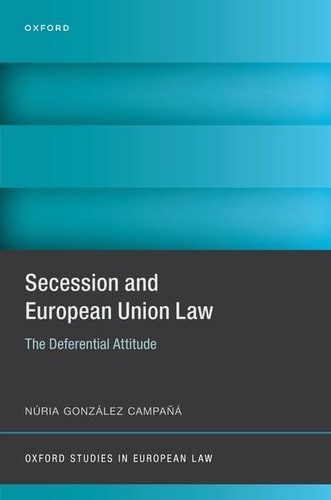
Secession and European Union Law: The Deferential Attitude
0
0
As an Amazon Associate and affiliate partner, Menrva Books earns from qualifying purchases. Learn more
Author Description
Secession is a live issue in today's Western Europe. In the last decade, we have witnessed the consolidation of pro-independence movements in Scotland and Catalonia and in the near future, we might see their re-emergence or the rise of other pro-secession movements in other European regions. The response of the EU institutions to secession within EU Member States may well be based mainly on political considerations. However, since the EU is a community based on the rule of law, it has also to justify its position with normative arguments of principle.Secession and European Union Law provides such normative support, drawing on a pluralist reading of the relation between EU law and national law, to support the conclusion that EU law should respect domestic constitutional orders. This book studies secession within EU Member States through legal methodology: the theoretical-doctrinal analysis of concepts and institutions, considering the evolving reality and case law. The legal approach has three dimensions, given the three different legal orders that interact at the EU level: international law, EU law and national constitutional law.Based on Article 4 (2) TEU, the central claim of this book is that the EU duty to respect national identity and fundamental constitutional structures generate obligations to respect Member States' constitutional orders, provided that the values enshrined in the Article are not violated by the Member State affected. Topical and original, Secession and European Union Law reviews and rethinks key features of the EU and the EU legal order.
Menrva's Summary
THE THESIS
This book investigates the legal obligations of the European Union regarding secessionist movements within its Member States. Núria González Campañá, a scholar of European law, utilizes a pluralist framework to analyze the intersection of international, EU, and national constitutional law. She argues that Article 4(2) of the Treaty on European Union mandates that the EU respect the constitutional orders and national identities of its Member States, provided those states uphold the fundamental values of the Union.
THE SCOPE MAP
What You Will Find
- Analysis of the interaction between international law, EU law, and national constitutional frameworks.
- Theoretical-doctrinal examination of secessionist concepts and institutional responses.
- Evaluation of Article 4(2) TEU as a mechanism for protecting Member State constitutional integrity.
- Case law review concerning pro-independence movements in regions such as Scotland and Catalonia.
THE AUTHORITY PERSPECTIVE
Legal scholars and practitioners identify this work as a rigorous examination of the intersection between sovereignty and supranational governance. Readers frequently note the academic density of the prose, which serves as a specialized resource for those studying the normative foundations of the European Union legal order.
Page Count:
288
Publication Date:
2024-01-01
Publisher:
Oxford University Press
ISBN-10:
0198882599
ISBN-13:
9780198882596
Politics
World politics
Law
International Law
Constitutional Law
Community Tags
Similar Books