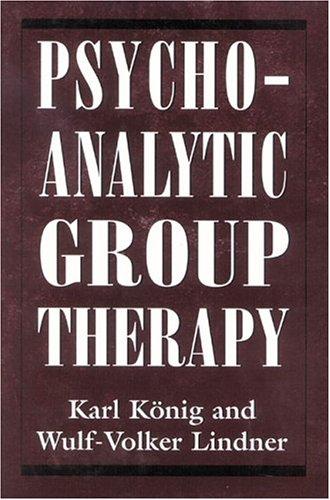
Psychoanalytic Group Therapy
0
0
As an Amazon Associate and affiliate partner, Menrva Books earns from qualifying purchases. Learn more
Author Description
Karl Konig and Wulf-Volker Lindner have distilled their many years of research, rich clinical experience, and extensive theoretical knowledge of analytic group psychotherapy. Now, for the first time in English, they present their Gottingen model of group therapy, a welcome addition to the literature that greatly extends our understanding of the complex processes of groups and their ability to promote growth and healing. Informed by Freudian, Foulkesian, and object relations approaches to individual and group analytic therapy, Konig and Lindner's extensive theoretical understanding of groups and individuals is saturated with a flexible common sense that moves comfortably between theory and practical application. They are at their best in explaining the transition between the therapist's essential human experience and his role in the group when they discuss such matters as the understanding of neutrality as a dynamic concept, the situations that trigger transference, and the functioning of the therapist as a model of openness. It is the transitional areas and forces that are the most in focus for the authors: those between individual and group, between group and therapist, between inside and outside, and between the learning of the therapist and the growth of group members. It is a testament to the authors' skill that they are able to explore these areas at the same time as they outline practical approaches to a full range of topics that need to be considered in the conduct of group therapy.
Menrva's Summary
THE THESIS
This book presents the Göttingen model of analytic group psychotherapy, synthesizing years of research and clinical experience. König and Lindner offer a comprehensive exploration of group processes, drawing from Freudian, Foulkesian, and object relations theories. They emphasize the transitional spaces between individual and group, group and therapist, and internal and external dynamics, detailing practical applications for therapists. The work bridges theoretical understanding with the realities of conducting group therapy, focusing on key aspects like neutrality, transference, and the therapist's role.
THE SCOPE MAP
- The Göttingen model of analytic group psychotherapy.
- Integration of Freudian, Foulkesian, and object relations theoretical approaches.
- Detailed discussion on the therapist's role, including neutrality and openness.
- Analysis of transitional dynamics: individual/group, group/therapist, inside/outside.
- Practical approaches to various topics in group therapy conduct.
- Exploration of transference triggers and the therapist as a model.
THE AUTHORITY PERSPECTIVE
This work is presented as a significant contribution to the literature on analytic group psychotherapy, offering the first English exposition of the Göttingen model. The authors' extensive theoretical knowledge and clinical experience are highlighted as foundational to their approach. The book is noted for its ability to balance complex theoretical discussions with practical applications, particularly in understanding the nuanced transitional areas within group dynamics. Its detailed examination of therapist neutrality, transference, and the therapist's modeling function is considered a key strength.
Page Count:
201
Publication Date:
1994-01-01
ISBN-10:
1568211198
Psychology
Non-Fiction
Therapy
Group Dynamics
Community Tags
Similar Books