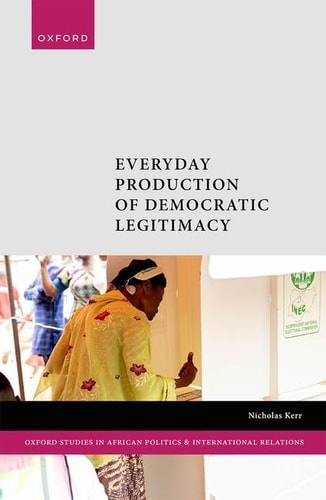
Electoral Commissions and Democratization in Africa: Everyday Production of Democratic Legitimacy
0
0
As an Amazon Associate and affiliate partner, Menrva Books earns from qualifying purchases. Learn more
Author Description
Why do some countries hold elections that meet global democratic standards, while other countries do not? Electoral Commissions and Democratization in Africa makes a novel contribution to this question. In a departure from the typical story about the “boring” administrative tasks that electoral commissions carry out and their impact on international observers' assessments of election quality, Kerr aruges that electoral commissions provide valuable information that helps politicians and citizens resolve uncertainties about electoral fraud and administrative irregularities.Whereas previous research focuses on the institutional design of electoral commissions, this book privileges their actual performance and focuses on two attributes: autonomy and capacity. By serving an informational role, the autonomy and capacity of electoral commissions influences how citizens and elites think about and behave during elections. This includes whether political elites and citizens participate in elections, engage in electoral fraud and violence, accept electoral outcomes, and express confidence in elections. These attitudes and behaviors, in turn, influence whether elections meet democratic standards (election quality) and whether political elites and citizens regard election processes as acceptable (election legitimacy).This book brings together evidence from public opinion surveys, elite surveys, field research, and cross-national databases to give an unusually rich empirical exploration of the dynamics of elections and democracy in sub-Saharan Africa since the 1990s, with a focused case study of Nigeria. Electoral Commissions and Democratization in Africa will be appealing to scholars and policymakers interested in democratization and elections.Oxford Studies in African Politics and International Relations is a series for scholars and students working on African politics and International Relations and related disciplines. Volumes concentrate on contemporary developments in Afric
Menrva's Summary
THE THESIS
This book investigates how the administrative performance of electoral commissions influences the production of democratic legitimacy and election quality in African nations. Nicholas Kerr, a scholar of African politics, challenges the conventional focus on institutional design by arguing that the autonomy and capacity of these commissions serve a critical informational role. By providing data that helps citizens and politicians navigate uncertainty regarding fraud and irregularities, these bodies directly shape electoral behavior, participation, and public confidence in democratic processes.
THE SCOPE MAP
What You Will Find
- Analysis of electoral commission autonomy and capacity as primary drivers of election outcomes.
- Empirical data derived from public opinion surveys, elite interviews, and cross-national databases.
- A detailed case study focusing on the electoral landscape of Nigeria since the 1990s.
- A theoretical framework linking administrative transparency to the reduction of political violence and fraud.
THE AUTHORITY PERSPECTIVE
Experts identify this work as a significant contribution to the study of African democratization, noting its shift from institutional theory to performance-based analysis. Scholars frequently highlight the book's methodological rigor and its utility for policymakers seeking to understand the mechanics of electoral integrity.
Page Count:
384
Publication Date:
2024-09-27
Publisher:
Oxford University Press
ISBN-10:
0198895364
ISBN-13:
9780198895367
History
Politics
International relations
Elections & Political Process
World politics
Elections
Public Policy
Democracy
Community Tags
Similar Books