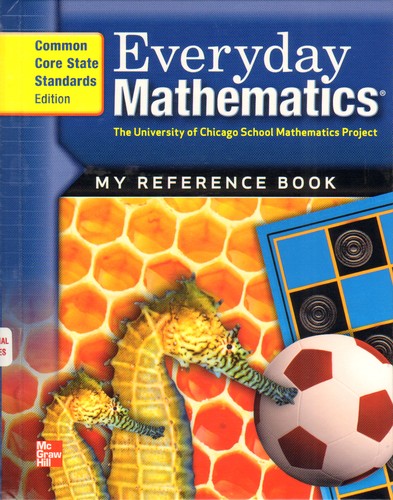
Everyday Mathematics
0
0
As an Amazon Associate and affiliate partner, Menrva Books earns from qualifying purchases. Learn more
Author Description
Everyday Mathematics enables students to build conceptual understanding, computational fluency, and real-world problem-solving skills. The University of Chicago School Mathematics Project continues to develop Everyday Mathematics to enable students to become strong mathematical citizens for the 21st century. Over the last 25 years Everyday Mathematics has grown from a Kindergarten field test to one of the most widely used elementary math programs in the United States. What accounts for this growth? The answer is simple. Students succeed in math when using Everyday Mathematics. Everyday Mathematics is a core curriculum for students in pre-kindergarten through sixth grade. At each grade level students are provided opportunities to learn concepts and practice skills in a variety of representations. A concept like fractions may first be introduced using a concrete representation such as base-ten blocks. Next the student may be asked to draw a pictorial representation of a fraction. A story problem may be introduced and finally an abstract representation of the fraction is introduced to the student. Using multiple representations of concepts helps students understand how abstract or formulaic representations of math are connected to the physical world. Everyday Mathematics' focus on real-life problem solving forces students to see how math touches their lives every day. Students are given the freedom to explore different ways of solving problems and taught how to communicate their mathematical thinking. These are recognized strengths of the Everyday Mathematics program and are a large part of the Common Core State Standards. In particular, the Standards of Mathematical Practice are covered extensively in Everyday Mathematics and have been at the heart of the program for the last 25 years when NCTM released a precursor to the Practice Standards called the Process Standards. The authors of Everyday Mathematics painstakingly reviewed the Common Core State Standards and real
Menrva's Summary
THE THESIS
Everyday Mathematics aims to foster conceptual understanding, computational fluency, and real-world problem-solving skills in students from pre-kindergarten through sixth grade. Developed by the University of Chicago School Mathematics Project, this core curriculum has grown significantly over 25 years by demonstrating student success. It employs multiple representations—concrete, pictorial, and abstract—to connect mathematical concepts to the physical world, ensuring students grasp how abstract formulas relate to reality. The program's emphasis on real-life problem-solving encourages students to see math's daily relevance and to explore diverse solution methods while articulating their mathematical thinking.
THE SCOPE MAP
- Coverage of mathematical concepts for pre-kindergarten through sixth grade.
- Use of multiple representations (concrete, pictorial, abstract) to teach concepts like fractions.
- Focus on real-life problem-solving to demonstrate the everyday application of mathematics.
- Opportunities for students to explore various problem-solving strategies.
- Emphasis on students communicating their mathematical thinking.
- Alignment with Common Core State Standards, particularly the Standards of Mathematical Practice.
THE AUTHORITY PERSPECTIVE
This curriculum is recognized for its sustained growth and widespread adoption in the United States over the past 25 years, attributed to its effectiveness in student success. Its pedagogical approach, emphasizing multiple representations and real-world problem-solving, aligns with contemporary educational standards like the Common Core State Standards for Mathematical Practice. The program's design reflects a long-standing commitment to developing strong mathematical citizens for the 21st century.
Page Count:
0
Publication Date:
2012-01-01
ISBN-10:
0076577252
ISBN-13:
9780076577255
Non-Fiction
Mathematics
Curriculum
Education
Community Tags
Similar Books