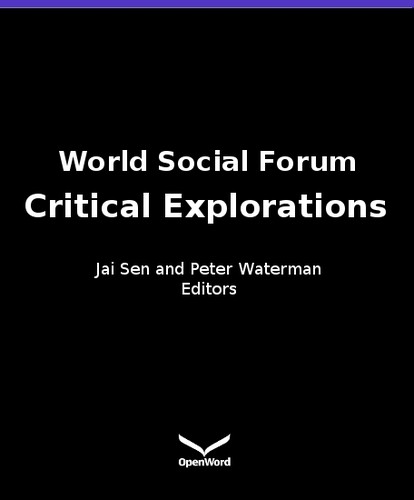
World Social Forum
0
0
As an Amazon Associate and affiliate partner, Menrva Books earns from qualifying purchases. Learn more
Author Description
“Be the change you want to see in the world.” (Mahatma Gandhi, activist and philosopher from India, 1869-1948, internationally respected for his doctrine of non-violence) Our world is today at a time of enormous change. On the one hand, there is tremendous scientific and technological change taking place, which in turn is contributing powerfully to widespread social and cultural change of many kinds; there are enormous changes in the world economy leading both to a massively growing concentration of wealth and also to a deepening and widening of precarity across the world; and we are in an accelerating and deepening ecological crisis as a consequence of massive overconsumption and the rape of Mother Earth. On the other hand, there is intensifying social and political resistance, now across the world and across many sections of societies, both to the negative impacts of all these changes and also to continuing structural injustice in all societies and to continuing colonialism – and also assertion, towards building a more just world. In many ways, the past two decades – the last of the 1900s and the first of the 2000s – have been an extraordinary period in all these terms. The movements seem to have peaked during the year 2011, with major protest movements and irruptions taking place in many places both in what is often now termed ‘the South’ – in some circles still referred to as ‘developing (or ‘emerging’) countries’ - as well as the North, the more industrialised countries. In some places it has already overthrown dictators, governments, and corporations, and forced others into retreat; and there are also now many signs of a growing massification of this upsurge, both within nations and across regions. Although the World Social Forum – formed precisely during this period and irruption, in 2001, in counter-position to the World Economic Forum and to neoliberalism more generally - may not be at the very centre of such movements (as has been claimed by some), it
Menrva's Summary
THE THESIS
The World Social Forum emerged as a significant counterpoint to the World Economic Forum and the prevailing neoliberal ideology. The text explores the profound global changes occurring in the early 21st century, driven by scientific and technological advancements, economic shifts leading to wealth concentration and precarity, and an escalating ecological crisis. It also highlights the concurrent rise of social and political resistance across diverse societies, challenging structural injustices, colonialism, and advocating for a more equitable world. The book positions the World Social Forum within this context of widespread protest movements that gained momentum around 2011, impacting both the Global South and North.
THE SCOPE MAP
- Analysis of the interconnectedness of scientific, technological, economic, and ecological changes shaping the contemporary world.
- Examination of the intensification of social and political resistance globally.
- Discussion of the role and positioning of the World Social Forum in relation to broader protest movements.
- Exploration of the period between the late 1900s and early 2000s as an extraordinary era of change and activism.
- Contextualization of the World Social Forum's formation in 2001 as a response to neoliberalism.
- Consideration of the impact of protest movements in overthrowing dictatorships and forcing corporate and governmental retreats.
THE AUTHORITY PERSPECTIVE
The provided text frames the World Social Forum as a response to global shifts and growing resistance, positioning it within a period of significant social and political upheaval. It acknowledges the forum's establishment in 2001 as a counter-movement to neoliberalism and the World Economic Forum. The description suggests the book analyzes the complex interplay of technological, economic, and ecological changes alongside social movements. It implies a focus on the global nature of these changes and the diverse forms of resistance emerging.
Page Count:
402
Publication Date:
2012-01-01
ISBN-10:
8188251178
ISBN-13:
9788190480826
Non-Fiction
Sociology
Activism
Community Tags
Similar Books