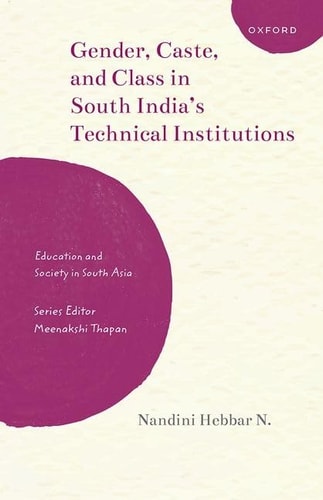
Gender, Caste, and Class in South India's Technical Institutions: Education and Society in South Asia
0
0
As an Amazon Associate and affiliate partner, Menrva Books earns from qualifying purchases. Learn more
Author Description
With a wide arc encompassing the institutional big men, who run technical institutes and colleges, and the micro-politics of friendships and relationships, this book is a deep dive into the world of Indian engineering colleges. It juxtaposes the stark realities and lived experiences of students against the global sensibilities and standards to which such institutes lay claim. From the 1980s to the early 2000s, Tamil Nadu witnessed a record rise in the number of private engineering colleges. However, despite the manifold increase in the number of institutions and consequently, first-generation learners, hierarchies and inequalities continue to be reproduced in these almost temple-like institutions. Groups lacking the explicit markers of cultural and social capital struggle to find employment. By presenting perspectives on engineering students desires, anxieties, and processes of self-construction, the monograph examines how gender differences are reinforced through language, rules, regulations, surveillance, and control. In shifting the theoretical emphasis from subjects to subjectivities, Hebbar draws on the youths narratives of upward social mobility, crafting respectability, and notions of adulthood, holding a mirror to the fraught social scape of Indias private education sector.
Menrva's Summary
THE THESIS
This book investigates how technical institutions in South India reproduce existing social hierarchies of caste, class, and gender despite the rapid expansion of private engineering education. Nandini Hebbar N. utilizes a sociological framework to examine the lived experiences of students in Tamil Nadu between the 1980s and the early 2000s. By analyzing the micro-politics of campus life and the institutional structures of control, the author argues that these colleges function as sites where social capital and cultural markers determine individual success and upward mobility.
THE SCOPE MAP
What You Will Find
- Analysis of the rapid proliferation of private engineering colleges in Tamil Nadu from the 1980s to the early 2000s.
- Examination of how institutional rules, surveillance, and language reinforce gendered expectations and social stratification.
- Qualitative data derived from student narratives regarding their anxieties, desires, and processes of self-construction.
- A theoretical focus on subjectivities and the pursuit of respectability among first-generation learners.
THE AUTHORITY PERSPECTIVE
Scholars in the field of South Asian sociology recognize this work as a significant contribution to the study of higher education and social reproduction. Readers frequently note the academic density of the prose and the author's nuanced approach to the intersectionality of caste and class within the Indian private education sector.
Page Count:
272
Publication Date:
2024-11-30
Publisher:
Oxford University Press
ISBN-10:
0198914458
ISBN-13:
9780198914457
Politics
Schools & Teaching
Education Theory
Gender Studies
Education
Education higher
Higher Education
Sociology
Community Tags
Similar Books