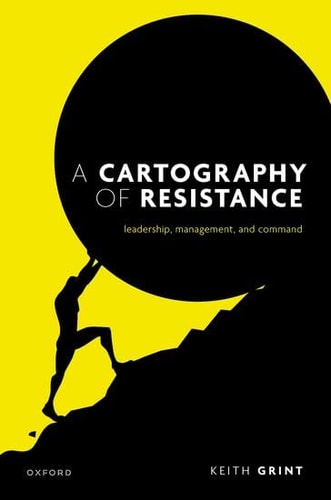
A Cartography of Resistance: Leadership, Management, and Command
0
0
As an Amazon Associate and affiliate partner, Menrva Books earns from qualifying purchases. Learn more
Author Description
Resistance is universal, but why does it occur, and fail or succeed? Resistance is often regarded in traditional management books as a problem to be overcome because it is seen as short-sighted or self-interested. Grint suggests, however, that resistance is not necessarily right or wrong. From resistance to the Roman Empire, to slavery, to the Nazis, to racism, to the state and capital, to patriarchy, and to imperialism, this book ranges across time and place to explain the success or failure of resistance.While many contemporary approaches focus on leadership as the explanatory variable, A Cartography of Resistance expands the approach to include management and command of resistance movements - and of their opponents. Many of the case studies explore the failures, as well as the successes, of resistance and the book suggests that even the failures reveal a fundamental truth about the human condition: just because the situation looks bleak for those suffering from oppression does not mean they surrendered meekly. Rather many seemed to adopt the same attitude that led Sisyphus to keep rolling the boulder up the hill: they were determined not to let their situation define or defeat them.
Menrva's Summary
THE THESIS
This book investigates the fundamental drivers of resistance, questioning why it occurs and determining the factors that lead to its success or failure. Professor Keith Grint, an expert in public leadership and management, challenges the traditional view that resistance is merely an obstacle to be managed. By examining the interplay between leadership, management, and command, he argues that resistance is a complex human phenomenon that reveals deep truths about the human condition and the refusal to be defined by oppressive circumstances.
THE SCOPE MAP
What You Will Find
- Historical case studies ranging from the Roman Empire and slavery to the fight against the Nazis and imperialism.
- A comparative analysis of leadership, management, and command strategies within resistance movements and their opposing forces.
- Theoretical frameworks that distinguish between the moral validity of resistance and its strategic efficacy.
- An exploration of the human condition through the lens of persistent struggle against systemic oppression.
THE AUTHORITY PERSPECTIVE
Experts recognize this work as a significant contribution to organizational theory, particularly for its interdisciplinary approach to power dynamics. Readers frequently note the academic rigor of the text, which effectively bridges historical analysis with contemporary management studies.
Page Count:
800
Publication Date:
2024-11-14
Publisher:
Oxford University Press
ISBN-10:
0198921756
ISBN-13:
9780198921752
History
Leadership & Motivation
Leadership
Management
Sociology
Community Tags
Similar Books