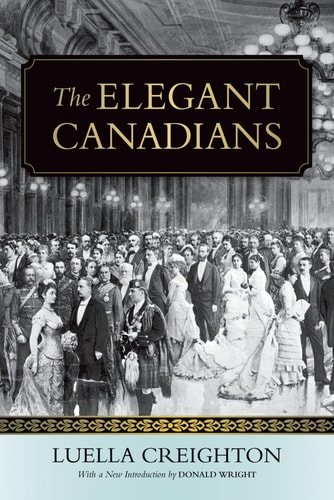
The Elegant Canadians
0
0
As an Amazon Associate and affiliate partner, Menrva Books earns from qualifying purchases. Learn more
Author Description
Opening with the Queen Victoria's arrival in Charlottetown harbor, visitors from the Old World emerge with erroneous expectations: they are constantly surprised that the New World is a place of energy, creativity, and imagination, reflected in exuberant architecture, dress, and culture. Elegance flourishes and society blossoms in gala events where long after midnight "the crinolines swayed, multicoloured and seemingly endowed with independent life of their own." In this lively mix of fact and fiction, Creighton is fascinated by the stuff of culture, here depicted as a distinctive weave of style, sophistication, and individuality with a unique Canadian character. Her fascination is also with cultural difference. In Canada there is undoubtedly unqualified elegance, but it is an edgier, harder-earned elegance than that of the pompous, baggage-bound Old World.Published in 1967, exactly one hundred years after Confederation, Creighton's book shows a Canada in the best of all possible worlds. Gone is pioneer poverty and environmental hardship, replaced now by thriving sophistication. At the same time, this is a world that still retains some respect for social hierarchy, decent manners, and old-fashioned inherited wisdom-the unspoken corollary here is that the Canada of 1967 has grown sloppy, noisy, and vulgar. Lovingly researched and assembled with sixty images, this depiction of Canada in the 1860s reveals much about our own history and myth-making.
Menrva's Summary
THE THESIS
This work investigates the evolution of Canadian cultural identity during the 1860s, questioning how a distinct, sophisticated national character emerged from the shadow of Old World expectations. The authors, Don Wright and Luella Creighton, utilize a blend of historical documentation and narrative observation to examine the transition from pioneer hardship to a society defined by elegance and creative expression. By contrasting the perceived rigidity of European social structures with the burgeoning, harder-earned refinement of post-Confederation Canada, the text argues that Canadian identity is rooted in a unique synthesis of inherited wisdom and local innovation.
THE SCOPE MAP
What You Will Find
- A detailed examination of Canadian social life, architecture, and fashion during the 1860s.
- An analysis of the cultural friction between European visitors and the realities of the Canadian landscape.
- A collection of sixty historical images documenting the aesthetic and social evolution of the era.
- A critical comparison between the idealized sophistication of the 1860s and the perceived cultural decline of the 1960s.
THE AUTHORITY PERSPECTIVE
Historians and cultural critics often cite this work as a significant artifact of 1967 centennial-era reflection, noting its focus on the intersection of myth-making and historical record. Readers frequently highlight the text's evocative prose and its ability to capture the specific social anxieties of the mid-twentieth century through the lens of the nineteenth century.
Page Count:
192
Publication Date:
2014-02-01
Publisher:
Oxford University Press
ISBN-10:
0199008523
ISBN-13:
9780199008520
Non-Fiction
History
Cultural History
Social History
Canadian History
Community Tags
Similar Books