Innovative Development
0
0
As an Amazon Associate and affiliate partner, Menrva Books earns from qualifying purchases. Learn more
Author Description
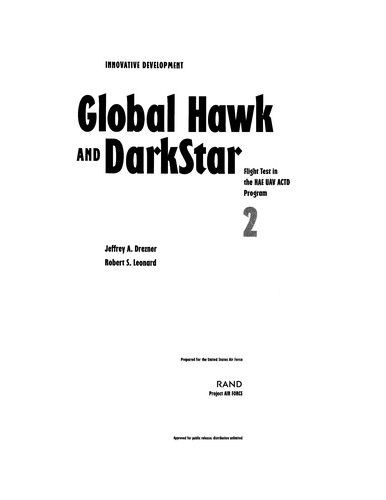
In 1994, the Defense Advanced Research Projects Agency and the Defense Airborne Reconnaissance Office launched a joint initiative with the goal to overcome the impediments that had hampered past unmanned aerial vehicle (UAV) development. This effort--designated the High-Altitude Endurance Unmanned Aerial Vehicle Advanced Concept Technology Demonstration (HAE UAV ACTD) program--applied an innovative acquisition strategy to the development of two UAVs: one conventionally configured (Global Hawk) and the other with a low-observable configuration (DarkStar). The report summarizes the major research findings regarding the HAE UAV ACTD program's acquisition strategy. The authors conclude that despite DarkStar's cancellation--and despite overall program cost growth and schedule slippage in basic design and test of the two HAE UAV concepts, the ACTD program did accomplish its primary objective by successfully demonstrating the military utility of a UAV with a continuous, all-weather, wide-area surveillance capability. Although the program's single requirement--the unit flyaway price--was not met, it did promote cost consciousness while at the same time preventing the imposition of additional system capabilities during the basic system development. The authors found the program's use of Other Transaction Authority to lend considerable flexibility to the effort. While the program's designation as an ACTD imposed cost and schedule. Boundaries that constrained system development, it also provided a high degree of flexibility to adjust the program execution. Areas of risk were addressed as they arose, and early flight test experience was assimilated into continuing system development efforts. Relatively modest changes in up-front planning processes, the structured participation of operational users early in the program, and contract language regarding oversight processes and incentives would ensure successful application of the acquisition strategy to a broader range of systems
Menrva's Summary
THE THESIS
This report analyzes the acquisition strategy employed in the High-Altitude Endurance Unmanned Aerial Vehicle Advanced Concept Technology Demonstration (HAE UAV ACTD) program. The program, a joint initiative by DARPA and DARO launched in 1994, aimed to overcome past impediments in UAV development by applying an innovative acquisition strategy to two distinct UAVs: the conventionally configured Global Hawk and the low-observable DarkStar. Despite DarkStar's cancellation and overall program cost growth, the report details how the ACTD program successfully demonstrated the military utility of a UAV capable of continuous, all-weather, wide-area surveillance, fulfilling its primary objective.
THE SCOPE MAP
- Analysis of the joint initiative by the Defense Advanced Research Projects Agency (DARPA) and the Defense Airborne Reconnaissance Office (DARO).
- Detailed examination of the High-Altitude Endurance Unmanned Aerial Vehicle Advanced Concept Technology Demonstration (HAE UAV ACTD) program.
- Comparison of two UAV development paths: the Global Hawk and the DarkStar.
- Summary of major research findings regarding the program's innovative acquisition strategy.
- Discussion of the program's success in demonstrating the military utility of advanced UAV surveillance capabilities.
- Evaluation of the program's adherence to the unit flyaway price requirement and its impact on cost consciousness.
- Assessment of the use of Other Transaction Authority for program flexibility and risk management.
THE AUTHORITY PERSPECTIVE
The report provides a detailed, analytical account of the HAE UAV ACTD program's acquisition strategy and its outcomes. It highlights the program's successes in demonstrating critical UAV capabilities, even amidst challenges like DarkStar's cancellation and schedule slippage. The authors offer specific findings on the effectiveness of the acquisition approach, particularly the use of Other Transaction Authority and the impact of the ACTD designation on flexibility and risk management. The analysis suggests areas for improvement in up-front planning, user participation, and contract language for broader application of similar strategies.
Page Count:
56
Publication Date:
2002-01-01
ISBN-10:
0833031120
Art
Science & Technology
History
Non-Fiction
Aerospace
Defense
Military Technology
Community Tags
Similar Books