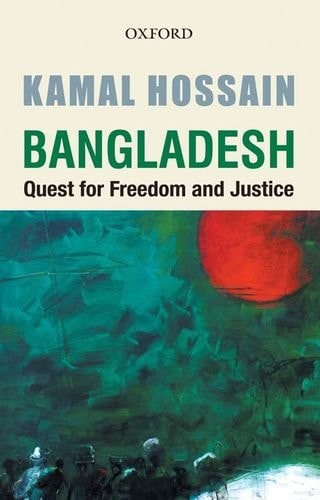
Bangladesh: Quest for Freedom and Justice
0
0
As an Amazon Associate and affiliate partner, Menrva Books earns from qualifying purchases. Learn more
Author Description
This insider's account deals in detail with the political developments that led to the emergence of independent Bangladesh. The post-independence challenges described here are a valuable source of information on different aspects of state building. Kamal Hossain gives us a vivid eyewitness account. His own involvement in different phases of the political struggle was intimate. It began from his personal association as legal defence for freedom of the media and victims of repression in the 1960s, in particular in the Agartala Conspiracy case. His later association with the Awami League's team at Ayub's Round Table Conference and, still later, with Yahya Khan in 1971, provides valuable historical insights into the events leading to Bangladesh's war of independence. After independence, as Minister of Law, Chairman of the Constitution Drafting Committee (1972), and later as Minister of Foreign Affairs, and of Petroleum and Minerals (1973-1975), he focuses on the challenges of state building and political transformation. He offers thoughtful analyses of how a country ravaged by war and deprived of resources managed to give itself a secular, democratic Constitution, won the respect of the world, gained membership of the United Nations and actively pursued peace and stability in the region. Bangladesh's pursuit of democracy was short lived as representative governance and secular, democratic politics were to be stifled by military rule. Bangladesh: Quest for Freedom and Justice as a political memoir offers critical insights into the processes of state formation in the initial years.
Menrva's Summary
THE THESIS
This work investigates the political evolution and state-building processes that defined the emergence of independent Bangladesh. Kamal Hossain, a central figure in the nation's early governance, utilizes his personal archives and eyewitness experiences to document the transition from political struggle to sovereign statehood. He provides a detailed analysis of the legal and diplomatic efforts required to establish a secular, democratic framework amidst the challenges of post-war reconstruction and resource scarcity.
THE SCOPE MAP
What You Will Find
- Detailed accounts of the 1960s political climate and the Agartala Conspiracy case.
- Insider perspectives on the negotiations during the Ayub Round Table Conference and the 1971 crisis.
- Analysis of the constitutional drafting process and the establishment of early ministerial priorities.
- Examination of the shift from representative governance to military rule in the mid-1970s.
THE AUTHORITY PERSPECTIVE
Experts identify this memoir as a foundational primary source for understanding the legal and political architecture of early Bangladesh. Readers frequently note the density of the prose, which provides a rigorous, firsthand account of the nation's formative years.
Page Count:
316
Publication Date:
2014-01-01
Publisher:
OUP
ISBN-10:
0199068534
ISBN-13:
9780199068531
Memoir
History
Biography
Politics
Bangladesh
South Asia
Pakistan
Community Tags
Similar Books