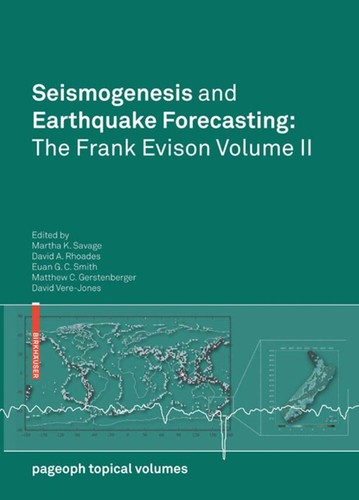
Seismogenesis and Earthquake Forecasting: The Frank Evison Volume II
0
0
As an Amazon Associate and affiliate partner, Menrva Books earns from qualifying purchases. Learn more
Author Description
This special issue of Pure and Applied Geophysics is the second of two volumes containing an augmented collection of papers originating from the Evison Symposium on Seismogenesis and Earthquake Forecasting held in Wellington, New Zealand, in February 2008. The volumes honor Frank Evison's interest in earthquake generation and forecasting. This volume includes descriptions of earthquake forecasting test centers through the Collaboratory for the Study of Earthquake Predictability (CSEP) program and the first results from the Regional Earthquake Likelihood Model (RELM) experiment in California. Other papers discuss methods of testing predictions, in particular by the use of error diagrams. There is discussion of prediction methodologies using seismicity, including an application of the statistical technique of Hidden Markov Models to identify changes in seismicity and a new technique for identifying precursory quiescence. Several papers employ other data besides seismicity, such as geologically determined faults, calculations of stress changes via Coulomb stress modeling, tomographically determined velocity structure, groundwater, crustal deformation, and comparisons of real earthquakes to synthetic seismicity determined from hypothesized earthquake physics. One paper focuses on the prediction of human casualties in the event that a large earthquake occurs anywhere on the globe. The volume will be useful to students and professional researchers who are interested in the earthquake preparation process and in converting that understanding into forecasts of earthquake occurrence.
Menrva's Summary
THE THESIS
This volume investigates the complex processes of seismogenesis and the challenges of earthquake forecasting. It presents an augmented collection of papers from the Evison Symposium, honoring Frank Evison's contributions to the field. The research explores earthquake forecasting test centers, initial results from experimental models, and methodologies for testing predictions. It also delves into various data sources and analytical techniques used to understand and predict earthquake occurrences.
THE SCOPE MAP
- Descriptions of earthquake forecasting test centers via the Collaboratory for the Study of Earthquake Predictability (CSEP) program.
- Presentation of initial results from the Regional Earthquake Likelihood Model (RELM) experiment in California.
- Discussion of methods for testing earthquake predictions, including the use of error diagrams.
- Exploration of prediction methodologies using seismicity, such as Hidden Markov Models and identification of precursory quiescence.
- Application of diverse data beyond seismicity, including geological faults, stress change calculations, tomographic velocity structure, groundwater, and crustal deformation.
- Comparisons of real earthquakes with synthetic seismicity derived from hypothesized earthquake physics.
- Analysis focused on the prediction of human casualties from potential large global earthquakes.
THE AUTHORITY PERSPECTIVE
This volume is presented as a valuable resource for students and professional researchers engaged with earthquake preparation and forecasting. The collection of papers offers insights into current methodologies and experimental results within the field. The inclusion of diverse data types and analytical approaches suggests a comprehensive overview of the state of research. The focus on practical applications, such as testing predictions and casualty assessment, indicates its relevance to both theoretical and applied seismology.
Page Count:
0
Publication Date:
2010-01-01
ISBN-10:
3034604998
ISBN-13:
9783034604994
Non-Fiction
Art
Science
Seismology
Scientific Research
Geophysics
Earth Science
Community Tags
Similar Books