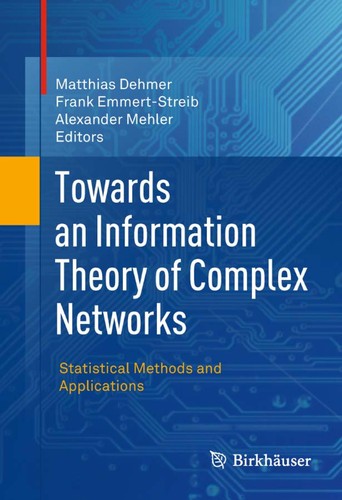
Towards an Information Theory of Complex Networks
0
0
As an Amazon Associate and affiliate partner, Menrva Books earns from qualifying purchases. Learn more
Author Description
For over a decade, complex networks have steadily grown as an important tool across a broad array of academic disciplines, with applications ranging from physics to social media. A tightly organized collection of carefully-selected papers on the subject, Towards an Information Theory of Complex Networks: Statistical Methods and Applications presents theoretical and practical results about information-theoretic and statistical models of complex networks in the natural sciences and humanities. The book's major goal is to advocate and promote a combination of graph-theoretic, information-theoretic, and statistical methods as a way to better understand and characterize real-world networks. This volume is the first to present a self-contained, comprehensive overview of information-theoretic models of complex networks with an emphasis on applications. It begins with four chapters developing the most significant formal-theoretical issues of network modeling, but the majority of the book is devoted to combining theoretical results with an empirical analysis of real networks. Specific topics include: chemical graph theory ecosystem interaction dynamics social ontologies language networks software systems This work marks a first step toward establishing advanced statistical information theory as a unified theoretical basis of complex networks for all scientific disciplines. As such, it can serve as a valuable resource for a diverse audience of advanced students and professional scientists. It is primarily intended as a reference for research, but could also be a useful supplemental graduate text in courses related to information science, graph theory, machine learning, and computational biology, among others.
Menrva's Summary
THE THESIS
This book investigates the application of information-theoretic and statistical methods to the analysis of complex networks. It aims to establish a unified theoretical basis for understanding real-world networks across various scientific disciplines by combining graph-theoretic, information-theoretic, and statistical approaches. The work begins with foundational theoretical issues before dedicating the majority of its content to empirical analysis and the integration of theoretical results with real network data. The book serves as a comprehensive overview of information-theoretic models for complex networks, emphasizing practical applications.
THE SCOPE MAP
- Theoretical and practical results on information-theoretic and statistical models of complex networks.
- Combination of graph-theoretic, information-theoretic, and statistical methods for network characterization.
- Empirical analysis of real networks, integrating theoretical findings.
- Specific topics include chemical graph theory, ecosystem interaction dynamics, social ontologies, language networks, and software systems.
- Establishment of advanced statistical information theory as a unified theoretical basis for complex networks.
- Applications in natural sciences and humanities.
THE AUTHORITY PERSPECTIVE
This work is presented as a comprehensive overview and a first step toward establishing advanced statistical information theory as a unified theoretical basis for complex networks. It is intended as a valuable resource for advanced students and professional scientists, serving primarily as a reference for research but also as a supplemental graduate text. The book's approach of combining theoretical and empirical analysis is highlighted as a key feature for understanding real-world networks.
Page Count:
395
Publication Date:
2011-01-01
ISBN-10:
0817649034
ISBN-13:
9780817649036
Non-Fiction
Art
Science
Information Science
Complex Networks
Statistical methods
Graph Theory
Machine Learning
Community Tags
Similar Books