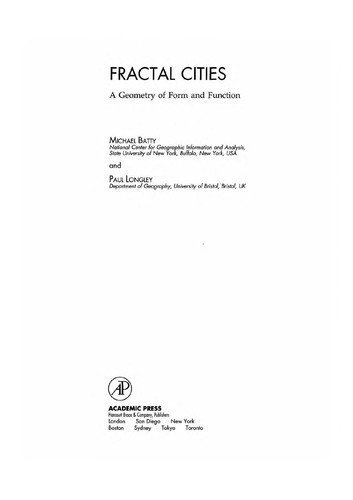
Fractal Cities
0
0
As an Amazon Associate and affiliate partner, Menrva Books earns from qualifying purchases. Learn more
Author Description
Fractal Cities is a pioneering study of the development and use of fractal geometry for understanding and planning the physical form of cities, showing how this geometry enables cities to be simulated through computer graphics. It shows how cities evolve and grow in ways that at first sight appear irregular, but which, when understood in terms of fractals, illustrate an underlying order that reveals their complexity and diversity. The book contains sixteen pages of stunning computer graphics and explanations of how to construct them, as well as new insights into the complexity of social systems. The authors provide a gentle and intelligible introduction to fractal geometry as well as an exciting visual understanding of the form of cities, thus providing one of the best introductions to fractal geometry available for non-mathematicians and social scientists. Fractal Cities can be used as a text for courses on geographic information systems, urban geography, regional science and fractal geometry. Planners and architects will also find that there are many aspects of fractal geometry in this book relevant to their own interests. Furthermore, those involved in fractals and chaos, computer graphics, and systems theory will find important methods and examples that are germane to their work.
Menrva's Summary
THE THESIS
The book investigates the application of fractal geometry to understanding and planning the physical form of cities. Michael Batty, a leading figure in urban studies, presents a study that demonstrates how fractal geometry can be used to simulate urban development through computer graphics. The work explains how seemingly irregular urban growth patterns reveal an underlying order, illustrating the complexity and diversity of cities. It offers new insights into social systems and provides an accessible introduction to fractal geometry for non-mathematicians and social scientists.
THE SCOPE MAP
- Application of fractal geometry to urban form and planning
- Methods for simulating cities using computer graphics
- Explanations and construction of sixteen pages of computer graphics
- New insights into the complexity of social systems
- An introduction to fractal geometry for non-mathematicians and social scientists
- Relevance for courses in geographic information systems, urban geography, regional science, and fractal geometry
- Information pertinent to planners, architects, and those in fractals, chaos, computer graphics, and systems theory
THE AUTHORITY PERSPECTIVE
This book is recognized as a pioneering study that bridges the gap between fractal geometry and urban planning. It is noted for its ability to provide both an intellectual understanding of complex urban systems and a visual appreciation through computer graphics. The work is considered a valuable resource for academics and professionals across multiple disciplines, including urban studies, mathematics, computer science, and architecture. Its accessible introduction to fractal geometry makes it particularly useful for those outside of pure mathematics.
Page Count:
94
Publication Date:
1994-01-01
ISBN-10:
0124555705
ISBN-13:
9780124555709
Non-Fiction
Architecture
Science
Systems Theory
Geography
urban planning
Mathematics
Computer graphics
Community Tags
Similar Books