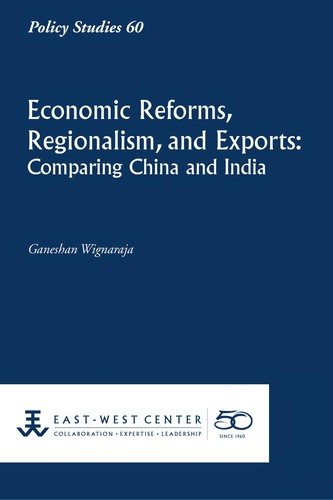
Economic Reforms, Regionalism, and Exports
0
0
As an Amazon Associate and affiliate partner, Menrva Books earns from qualifying purchases. Learn more
Author Description
This paper undertakes a comparative empirical assessment of economic reforms and exports in the rising Asian giants, China and India. It explores the past record and future challenges. In recent years, China has surged ahead of India to dominate world manufactured exports, but India has acquired competitive capabilities in skill-intensive services. Favorable initial conditions (e.g., large markets and low-cost productive labor) shaped the giants' success. While the gradual switch to market-oriented reforms in the late-1970s drove trade-led growth in the giants, China was swifter and more coordinated. It introduced an open door policy towards foreign direct investment (FDI), actively facilitated technological upgrading of FDI, steadily liberalized a controlled import regime, ensured a competitive exchange rate, and concluded more comprehensive free trade agreements (FTAs) with Asian developing economies. India has attempted to enact economic reforms since 1991, particularly to attract FDI and liberalize imports. Therefore, one might expect the gap in trade performance between China and India to narrow over time. However, both giants face an uncertain world economy after the global financial crisis, and future success will depend on evolving reforms. Critical areas are how the giants respond to integrating with production networks, promote technology development, manage real exchange rates, and mitigate the risk of protectionism.
Menrva's Summary
THE THESIS
This paper empirically assesses the impact of economic reforms on export performance in China and India, two major Asian economies. The author, Ganeshan Wignaraja, examines their past achievements and future challenges in global trade. While China has surpassed India in manufactured exports, India has developed strengths in skill-intensive services, with both nations benefiting from favorable initial conditions like large markets and abundant labor. The paper argues that while both countries pursued market-oriented reforms, China's more coordinated and rapid implementation, including its open-door policy for FDI and trade liberalization, led to swifter trade-led growth.
THE SCOPE MAP
- Comparative empirical assessment of economic reforms and exports in China and India.
- Analysis of past export records and future challenges for both nations.
- Examination of factors contributing to China's dominance in manufactured exports and India's strength in services.
- Discussion of initial conditions (market size, labor costs) shaping success.
- Evaluation of the impact of market-oriented reforms and trade liberalization.
- Comparison of China's FDI policies and technological upgrading with India's reforms since 1991.
- Identification of critical areas for future success: integration with production networks, technology development, exchange rate management, and protectionism mitigation.
THE AUTHORITY PERSPECTIVE
The paper provides a detailed comparative analysis of China and India's economic reforms and their impact on export performance. It highlights the distinct strategies and outcomes of each nation, offering insights into the factors driving their trade success. The analysis suggests that while India has made strides, China's more coordinated approach to reforms and integration into global markets has given it a significant advantage. The work concludes by outlining key challenges and areas for future policy focus for both economies in an uncertain global economic landscape.
Page Count:
81
Publication Date:
2011-01-01
ISBN-10:
1932728945
ISBN-13:
9781932728941
Non-Fiction
Economics
Trade
Community Tags
Similar Books