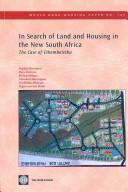
In Search of Land and Housing in the New South Africa
0
0
As an Amazon Associate and affiliate partner, Menrva Books earns from qualifying purchases. Learn more
Author Description
This study describes the saga of how one community, instead of squatting in an informal settlement or invading a new plot of land, attempted to buy land legally and build their own houses in a peri-urban area, using their own savings. The Ethembalethu story draws attention to the many challenges that poor people face accessing land and housing in South Africa. The purpose of this case study is to highlight the complex challenges that face poor communities that attempt to secure their constitutionally mandated rights to adequate housing. These challenges stem from inconsistent or inadequate policies and legislation, confusion between the myriad agencies involved, lack of clarity over responsibilities and accountability, lack of capacity of the implementing agencies, the rising costs and delays in accessing building materials, corruption, and the absence of information and training of both government officials and the housing hopefuls. Finally, the case highlights the Not-In-My-Back-Yard (NIMBY) ferocity with which wealthier citizens may still resist change in the new South Africa. This report draws practical lessons from the case study and makes suggestions for reforms. This report is organized as follows. It begins with a narrative of events, starting in 1996 and ending in 2006. It draws the key lessons emerging from this experience. It then investigates the main issues, and suggests reforms and improvements in the following areas: (i) improving access to land; (ii) simplifying and aligning legal procedures; (iii) designing a land and housing program for peri-urban areas; and (iv) reforming the land market. The report concludes with a call for further participatory action research.
Menrva's Summary
THE THESIS
This study investigates the complex challenges faced by poor communities in South Africa attempting to legally acquire land and build their own homes. The Ethembalethu community's decade-long saga, from 1996 to 2006, highlights the systemic obstacles they encountered, including inconsistent policies, bureaucratic confusion, lack of agency capacity, rising material costs, corruption, and resistance from wealthier citizens. The report details their efforts to buy land and construct houses using their own savings, drawing practical lessons from their experience to suggest reforms.
THE SCOPE MAP
- A narrative of events detailing a community's struggle for land and housing from 1996 to 2006.
- Analysis of challenges including policy inconsistencies, agency confusion, capacity issues, material costs, corruption, and NIMBYism.
- Practical lessons derived from the Ethembalethu case study.
- Suggestions for reforms in improving access to land, simplifying legal procedures, designing peri-urban programs, and reforming the land market.
- A call for further participatory action research.
THE AUTHORITY PERSPECTIVE
This report is presented as a case study offering practical lessons and reform suggestions for land and housing access in South Africa. The analysis focuses on the systemic issues that hinder poor communities from securing their constitutional rights, drawing from a specific decade-long community effort. The work aims to inform policy and practice by detailing the complexities of land acquisition and housing development in the post-apartheid era.
Page Count:
40
Publication Date:
2008-01-01
ISBN-10:
0821373730
ISBN-13:
9780821373736
History
Politics
Non-Fiction
urban planning
Housing policy
South Africa
Community Tags
Similar Books