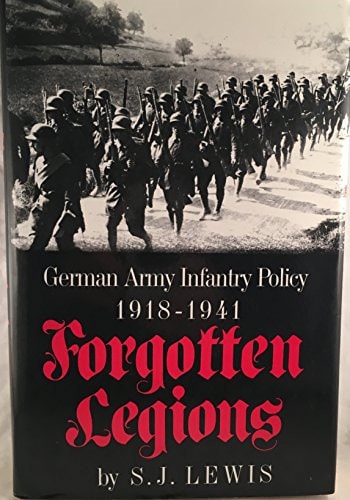
Forgotten legions: German Army infantry policy, 1918-1941
0
0
As an Amazon Associate and affiliate partner, Menrva Books earns from qualifying purchases. Learn more
Author Description
Forgotten Legions presents a comprehensive history of the German Army infantry policy from the end of World War I to early 1942 and the many influences that shaped its development. Samuel J. Lewis explores in detail all of the tactical innovations and the concomitant organizational and armament changes that were instituted by the German Army General Staff. Through an examination of General Staff's policy achievements and failures, Lewis shows how at first the infantry functioned brilliantly in World War II, and how it later ceased to function as its leaders lost a series of running political battles with the single-party totalitarian dictatorship. He includes informative summaries of German campaigns to provide continuity and a framework against which development of the German infantry can be compared, and also analyzes selected combat engagement as examples of typical experiences of the various campaigns.
Menrva's Summary
THE THESIS
This work investigates the evolution of German Army infantry policy between 1918 and 1941 to determine how tactical, organizational, and armament changes influenced the effectiveness of German forces during the early stages of World War II. Samuel J. Lewis, a military historian, utilizes archival research and General Staff records to trace the institutional development of the infantry. He argues that while the infantry initially performed with high efficiency, its operational capacity eventually degraded due to political interference from the totalitarian leadership of the Third Reich.
THE SCOPE MAP
What You Will Find
- Analysis of German Army General Staff policy and decision-making processes
- Examination of tactical innovations and armament shifts within the infantry
- Comparative summaries of major German military campaigns
- Case studies of specific combat engagements
Scope Limits
- The study concludes in early 1942 and does not cover the entirety of the war
- The focus is primarily on infantry policy rather than broader naval or air force strategy
THE AUTHORITY PERSPECTIVE
Experts recognize this text as a specialized study of the internal mechanisms of the German military establishment during the interwar and early war periods. Readers frequently note the academic density of the prose and the author's focus on the intersection of military doctrine and political pressure.
Page Count:
189
Publication Date:
1985-01-01
Publisher:
Praeger
ISBN-10:
0030043697
ISBN-13:
9780030043697
History
German history
Germany
Europe
World War
Technology history
Military Strategy
Science & Math
Technology
Military History
Infantry Tactics
Community Tags
Similar Books