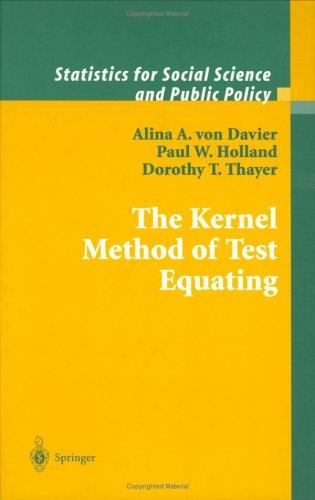
The Kernel Method of Test Equating
0
0
As an Amazon Associate and affiliate partner, Menrva Books earns from qualifying purchases. Learn more
Author Description
Kernel Equating (KE) is a powerful, modern and unified approach to test equating. It is based on a flexible family of equipercentile-like equating functions and contains the linear equating function as a special case. Any equipercentile equating method has five steps or parts. They are: 1) pre-smoothing; 2) estimation of the score-probabilities on the target population; 3) continuization; 4) computing and diagnosing the equating function; 5) computing the standard error of equating and related accuracy measures. KE brings these steps together in an organized whole rather than treating them as disparate problems. KE exploits pre-smoothing by fitting log-linear models to score data, and incorporates it into step 5) above. KE provides new tools for diagnosing a given equating function, and for comparing two or more equating functions in order to choose between them. In this book, KE is applied to the four major equating designs and to both Chain Equating and Post-Stratification Equating for the Non-Equivalent groups with Anchor Test Design. This book will be an important reference for several groups: (a) Statisticians and others interested in the theory behind equating methods and the use of model-based statistical methods for data smoothing in applied work; (b) Practitioners who need to equate tests—including those with these responsibilities in testing companies, state testing agencies and school districts; and (c) Instructors in psychometric and measurement programs. The authors assume some familiarity with linear and equipercentile test equating, and with matrix algebra. Alina von Davier is an Associate Research Scientist in the Center for Statistical Theory and Practice, at Educational Testing Service. She has been a research collaborator at the Universities of Trier, Magdeburg, and Kiel, an assistant professor at the Politechnical University of Bucharest and a research scientist at the Institute for Psychology in Bucharest. Paul Holland holds the Frederic M. Lo
Menrva's Summary
THE THESIS
The Kernel Equating method offers a unified approach to test equating, integrating disparate steps into a cohesive framework. This book details the Kernel Equating (KE) method, a modern technique based on a flexible family of equipercentile-like equating functions, with linear equating as a special case. It outlines the five key steps involved: pre-smoothing, probability estimation, continuization, equating function computation, and standard error calculation. KE specifically leverages log-linear models for pre-smoothing and provides new diagnostic tools for comparing equating functions.
THE SCOPE MAP
- Detailed explanation of the five steps of equipercentile equating: pre-smoothing, probability estimation, continuization, equating function computation, and standard error calculation.
- Application of Kernel Equating (KE) to four major equating designs.
- Specific application of KE to Chain Equating and Post-Stratification Equating for the Non-Equivalent groups with Anchor Test Design.
- Discussion of log-linear models for data smoothing within the KE framework.
- Introduction of new diagnostic tools for evaluating and comparing equating functions.
- Target audience includes statisticians, psychometricians, and practitioners involved in test equating.
- Assumes familiarity with linear and equipercentile test equating, and matrix algebra.
THE AUTHORITY PERSPECTIVE
This book is positioned as an important reference for statisticians interested in the theory and application of model-based statistical methods, and for practitioners who need to equate tests in various educational and testing contexts. The authors assume a certain level of prior knowledge in test equating and matrix algebra, suggesting a specialized audience. The detailed methodology and application to specific designs indicate a focus on practical implementation and theoretical depth for those working within psychometrics and measurement.
Page Count:
229
Publication Date:
2003-01-01
ISBN-10:
0387019855
ISBN-13:
9780387019857
Science
Non-Fiction
Psychometrics
Education
Methodology
Statistics
Community Tags
Similar Books