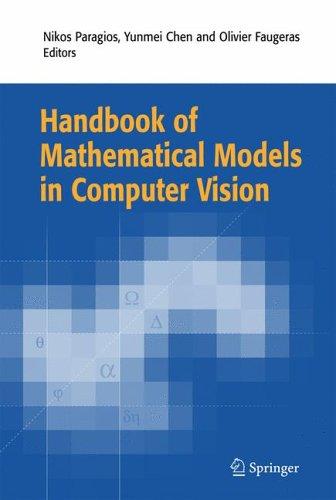
Handbook of Mathematical Models in Computer Vision
0
0
As an Amazon Associate and affiliate partner, Menrva Books earns from qualifying purchases. Learn more
Author Description
Visual perception refers to the ability of understanding the visual information that is provided by the environment. Such a mechanism integrates several human abilities and was studied by many researchers with different scientific origins including philosophy, physiology, biology, neurobiology, mathematics and engineering. In particular in the recent years an effort to understand, formalize and finally reproduce mechanical visual perception systems able to see and understand the environment using computational theories was made by mathematicians, statisticians and engineers. Such a task connects visual tasks with optimization processes and the answer to the visual perception task corresponds to the lowest potential of a task-driven objective function. In this edited volume we present the most prominent mathematical models that are considered in computational vision. To this end, tasks of increasing complexity are considered and we present the state-of-the-art methods to cope with such tasks. The volume consists of six thematic areas that provide answers to the most dominant questions of computational vision: Image reconstruction, Segmentation and object extraction, Shape modeling and registration, Motion analysis and tracking, 3D from images, geometry and reconstruction Applications in medical image analysis
Menrva's Summary
THE THESIS
This handbook explores the foundational mathematical models underpinning computer vision systems. The book delves into the computational theories and optimization processes that enable machines to perceive and understand visual information, drawing from diverse scientific origins. It presents state-of-the-art methods for tasks of increasing complexity, connecting visual challenges with mathematical frameworks where solutions correspond to the minima of objective functions.
THE SCOPE MAP
- Mathematical models for image reconstruction
- Techniques for segmentation and object extraction
- Methods in shape modeling and registration
- Models for motion analysis and tracking
- Approaches to 3D reconstruction from images
- Geometric principles in computer vision
- Applications in medical image analysis
THE AUTHORITY PERSPECTIVE
This handbook is recognized as a comprehensive compilation of mathematical models crucial for computer vision. It is structured to address dominant questions within the field, covering a wide array of tasks from basic image processing to complex 3D reconstruction and medical applications. The collection is designed for researchers and practitioners seeking to understand the theoretical underpinnings of visual perception systems. The mathematical rigor and breadth of topics make it a valuable resource for advancing computational vision.
Page Count:
605
Publication Date:
2005-01-01
ISBN-10:
0387263713
ISBN-13:
9780387263717
Science
Non-Fiction
Computer Vision
Machine Learning
Image Processing
Mathematical Models
Community Tags
Similar Books