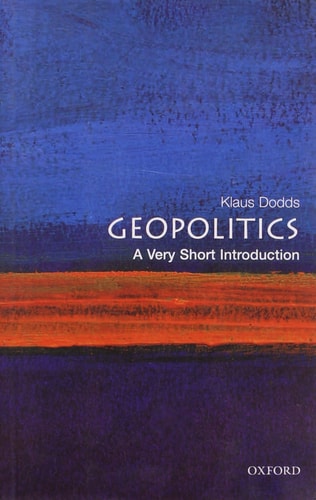
Geopolitics: A Very Short Introduction
0
0
As an Amazon Associate and affiliate partner, Menrva Books earns from qualifying purchases. Learn more
Author Description
In places such as Iraq or Lebanon, moving a few feet on either side of a territorial boundary can be a matter of life or death, dramatically highlighting the connections between geography and politics. This Very Short Introduction illuminates the concept of geopolitics, revealing how a country's location and size as well as its sovereignty and resources all affect how its people understand and interact with the wider world. Using wide-ranging examples, from historical maps to James Bond films and the rhetoric of political leaders like Churchill and George W. Bush, Klaus Dodds describes how people and places are inter-connected with each other, and how our geopolitical outlook molds our understanding of the world. He shows why it is vital that we understand how and why we divide the world into zones and territories--and how these divisions depend on your perspective. The book explains how terrorism, globalization, environmental degradation, and new technologies such as the internet are all challenging the geographical basis of global politics, and it sheds light on the history of terms such as "the iron curtain," "the third world," and "the axis of evil."About the Series: Oxford's Very Short Introductions offers concise and original introductions to a wide range of subjects--from Islam to Sociology, Politics to Classics, and Literary Theory to History. Not simply a textbook of definitions, each volume provides trenchant and provocative--yet always balanced and complete--discussions of the central issues in a given topic. Every Very Short Introduction gives a readable evolution of the subject in question, demonstrating how it has developed and influenced society. Whatever the area of study, whatever the topic that fascinates the reader, the series has a handy and affordable guide that will likely prove indispensable.
Menrva's Summary
THE THESIS
How does the intersection of geography and political power shape our understanding of global boundaries and national identity? Klaus Dodds, a professor of geopolitics, examines the historical and contemporary mechanisms that define how states and individuals perceive territory. By analyzing the influence of location, sovereignty, and resources, the author provides a framework for interpreting how geopolitical narratives are constructed and maintained in an increasingly interconnected world.
THE SCOPE MAP
What You Will Find
- Analysis of historical and modern territorial boundaries and their impact on global stability.
- Examination of cultural artifacts, including cinema and political rhetoric, as tools for shaping geopolitical outlooks.
- Discussion of contemporary challenges to traditional geography, such as globalization, environmental degradation, and digital technology.
- Historical context for influential geopolitical terminology like the Iron Curtain and the Axis of Evil.
THE AUTHORITY PERSPECTIVE
Experts and readers frequently cite this volume as a highly accessible entry point into the complex field of political geography. The text is noted for its ability to synthesize dense academic concepts into a concise format suitable for students and general readers alike.
Page Count:
182
Publication Date:
2007-12-03
Publisher:
Oxford University Press
ISBN-10:
0199206589
ISBN-13:
9780199206582
Politics
History
Social Science
International relations
Geography
Community Tags
Other Editions(5)

Similar Books



Reader Comments
Share Your Thoughts
No comments yet. Be the first to share your thoughts!