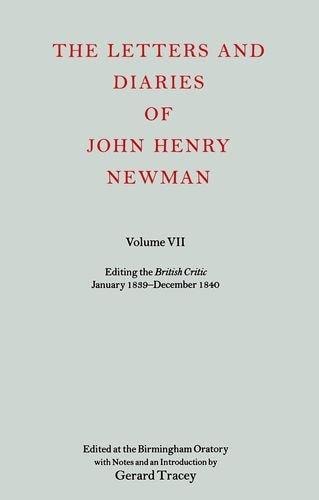
The Letters and Diaries of John Henry Newman: Vol. VII: Editing the British Critic January 1839--December 1840
0
0
As an Amazon Associate and affiliate partner, Menrva Books earns from qualifying purchases. Learn more
Author Description
John Henry Newman (1801-90) was at the height of his position in the Church of England in 1839, when he first began to feel doubts concerning the claims of the Anglican Church. His editorship of the British Critic took up a great deal of time, but he was greatly encouraged by its increasing sales. Uncomfortable with his position as Vicar of St Mary's, Oxford Newman was considering giving up the position at the end of 1840. This volume covers a significant period in Newman's life, with a background of social ferment and political tension: the Corn Laws, Chartism, an inexperienced monarch, weak government, and foreign problems. Contemporary writers such as Carlyle attracted Newman's attention, and university reform was a live issue.
Menrva's Summary
THE THESIS
This volume investigates the pivotal transition in John Henry Newman's theological and professional life as he navigated the internal conflicts of the Anglican Church while managing the British Critic. Newman, a prominent figure in 19th-century religious history, utilizes his personal correspondence and private journals to document his shifting ecclesiastical loyalties. The text provides a primary source account of his intellectual development against the backdrop of Victorian social and political instability. By examining these documents, the author reveals the intersection of personal doubt and public responsibility during a period of significant institutional change.
THE SCOPE MAP
What You Will Find
- Primary source documentation covering the years 1839 to 1840.
- Detailed insights into the editorial management of the British Critic.
- Contextual analysis of contemporary social issues including the Corn Laws and Chartism.
- Personal reflections on the role of the Vicar of St Mary's, Oxford.
THE AUTHORITY PERSPECTIVE
Scholars and historians regard this volume as a critical resource for understanding the intellectual climate of the Oxford Movement. Readers frequently note the academic density of the prose, which serves as a foundational text for those studying Newman's eventual conversion.
Page Count:
576
Publication Date:
1995-06-29
Publisher:
Oxford University Press
ISBN-10:
0199204020
ISBN-13:
9780199204021
History
Religion
Biography
Theology
Diaries
Letters
Community Tags
Similar Books